
As a student of gender studies, a feminist, and someone who spent most of her life outside of the US, I wanted to be a part of the Mumbai seminar for the ways in which it brought my academic interests–feminism, postcolonialism, performance, transnationalism, etc.–into the context of a global South Asian city, somewhere that is “not-US”. I wanted to see how the perspectives and theoretical tools I gained in the classroom at Barnard would change, or if they would at all. How would these often abstract theories inform or alter the ways in which I experience a city which: a) has a colonial history, b) is still strongly involved in feminist struggles, and c) is constantly undergoing cultural, economic, and social change due to the influences of the West and of capitalism, very much like my own home of Taipei?

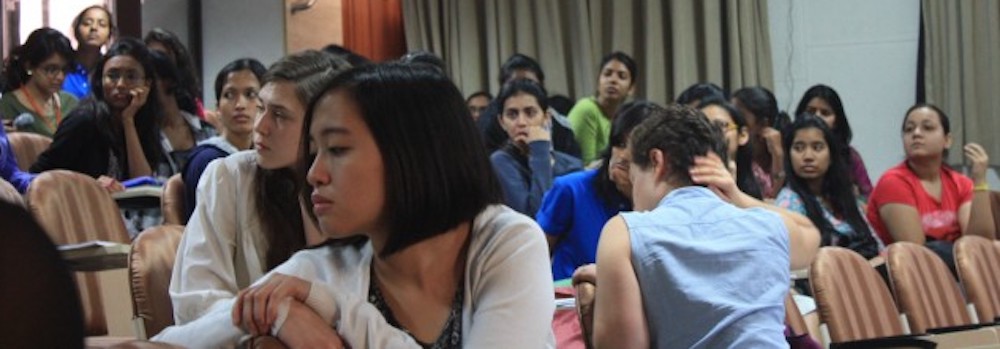
Nicci Yin, center, at the Mumbai Winter Seminar
Aside from my own curiosities on how the seminar would place theory in dialogue with lived experience, some of the biggest questions that emerged from this cross-cultural exchange between Mumbai and New York were: in what ways do women inhabit or occupy space (or are prevented from doing so)? What specific negotiations need to take place for women to occupy urban space, specifically within cities like New York, Mumbai, and Delhi? The word ‘occupy’ is also somewhat deliberate, as it seems that the energy from Occupy as a movement seems to have influenced the tone of the protests surrounding female and feminist occupations of space, ignited by the Delhi gang rape. Though the rape took place around 900 miles away from where we were, it remained on our minds throughout our conversations within these seminars and outside of them.
Being in a foreign city already makes you especially attentive to what spaces you can or cannot occupy as an outsider. As students from New York, we were curious as to the spaces the students from Sophia and Lady Shri Ram Colleges for Women could occupy in their own cities. To that end, we specifically exchanged personal anecdotes of living in the city as women; the most common questions we asked each other had to do with street harassment and safety, and in doing so, engaged in a transnational feminist dialogue of sorts through the sharing of personal experiences. Our friends from Lady Shri Ram mentioned that they personally didn’t feel as safe to wander around Delhi at night as they did in Mumbai. When talking about street harassment in NYC, I felt stuck when a student from Sophia asked, “So do you say something to them?” The question only underlined the paralysis that ends up taking the place of speaking up when we do get catcalled on the streets.
Continue reading http://www.tb-credit.ru/zaim-bez-otkaza.html http://www.tb-credit.ru/zaimy-online.html