Events
Upcoming
Maja Horn, Carlos U. Decena, Rosamond S. King, Mariley Melo, and Frances Negrón-Muntaner
Join us for an intergenerational conversation in celebration of Maja Horn's Queer Genealogies in Dominican Literature and Culture (University Press of Florida, 2025).
Past events
Mizue Aizeki, Luba Cortés, and Natalia Aristizábal, moderated by Miriam Ticktin
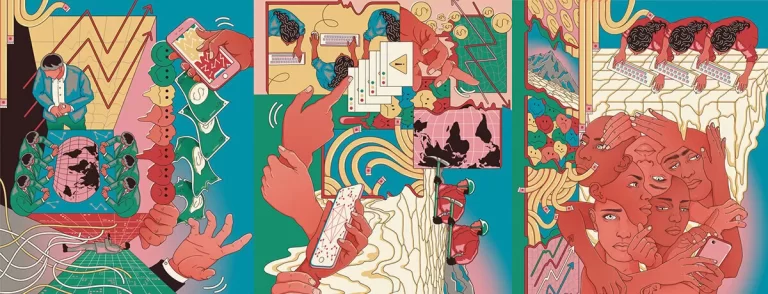
For this year's Helen Pond McIntyre ’48 Lecture, join Mizue Aizeki (Executive Director, Collaborative Research Center for Resilience), and Make the Road New York’s Luba Cortés (Civil Rights and Immigration Lead Organizer) and Natalia Aristizabal (Deputy Director) for a public conversation on surveillance technology, AI, and immigrant justice.
Meredith Broussard and Lauren Klein
Why AI Needs Feminism brings together feminist critical technologists Lauren Klein (Emory University) and Meredith Broussard (NYU) with Barnard’s Saima Akhtar (Vagelos Computational Science Center) and Gabrielle Gutierrez (Neuroscience) to examine how algorithmic surveillance is reshaping everyday life—from predictive policing in New York neighborhoods of color to the data infrastructures sustaining global conflicts and occupations. This conversation challenges the myth of “data-driven decision-making” as neutral progress and asks how feminist approaches grounded in care and accountability can offer paths toward refusal and repair.
Sarah Haley, Emily Thuma, Sandra Moyano-Ariza, and Rebecca Jordan-Young
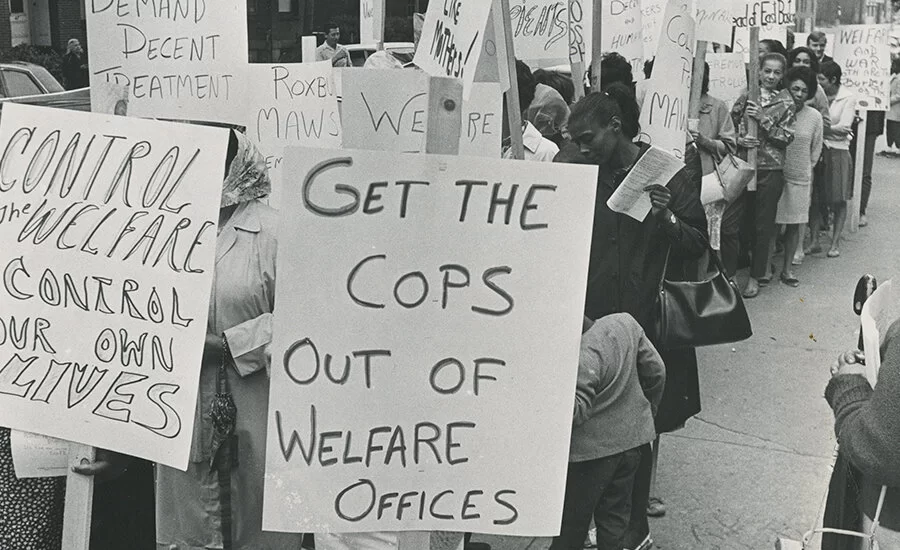
Join the editors of The Scholar and Feminist Online to celebrate the Fall 2025 issue, “Abolition Feminism and the Politics of Reproduction.” The conversation explores the issue’s development, key themes, and how abolition feminism examines and reimagines the gendered, racialized, and classed systems shaping everyday life and social reproduction.
Anupama Rao and C. Riley Snorton
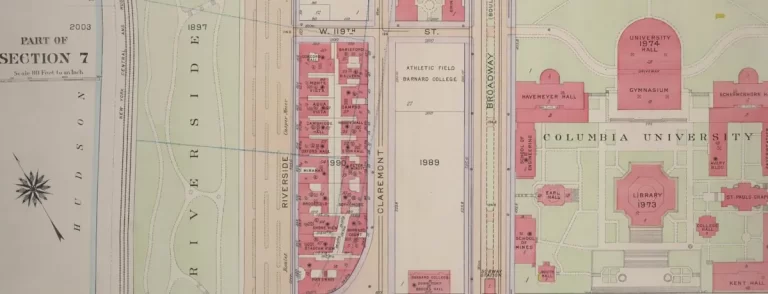
Student-led symposium exploring universities’ roles in society, examining social inequality, segregation, and education through critical research, archives, and activism, connecting campus histories with broader political structures.
Gina Rippon and Rebecca Jordan-Young
For decades, autism research has focused overwhelmingly on boys and men, and some autism researchers even see autism itself as “masculine.” Drawing on her own decades of research with autistic women and girls, Neuroscientist Gina Rippon upends this view. Beyond highlighting autism’s manifestations in women and girls, Rippon’s research illuminates the entangled matter of gender/sex, autism, and neuroscience, and exposes the devastating effects of systemic gender bias in autism research and services.
Justine McConnell, Monica L. Miller, and Rosa Andújar
Join us for the Natalie Boymel Kampen Memorial Lecture with Justine McConnell, McMillan-Stewart Fellow at Harvard University and Reader in Comparative Literature and Classical Reception at King’s College London. McConnell's lecture, “‘Wayward’ Mythography: Zora Neale Hurston and Ancient Greece,” will be followed by a conversation co-moderated by Monica Miller (Africana Studies, Barnard) and Rosa Andújar (Classics, Barnard). The event will conclude with a Q&A with audience members.
Neriko Musha Doerr, Devin Walker, Abosede George, and Tamara J. Walker
Marisa Solomon, J.T. Roane, Mon Mohapatra, and C. Riley Snorton
Join us for an exciting book salon in celebration of Barnard Assistant Professor of Women’s, Gender, Sexuality Studies Marisa Solomon’s The Elsewhere Is Black: Ecological Violence and Improvised Life with J.T. Roane (Geography, Rutgers) and Mon Mohapatra (Community Justice Exchange), moderated by C. Riley Snorton (English & Comparative Literature and ISSG, Columbia).
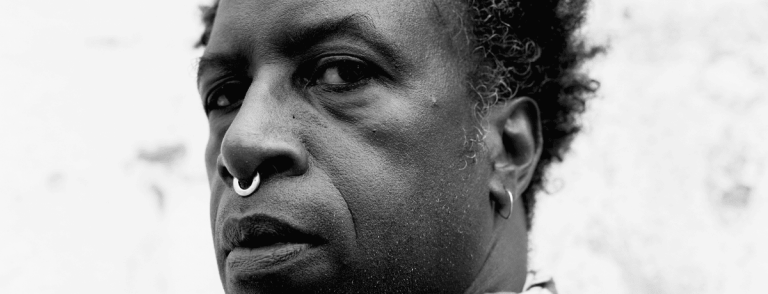
Saul Williams and Shana L. Redmond
Poet, musician, filmmaker, actor and intellectual Saul Williams discusses the relationships between aesthetic forms and political education in conversation with Dr. Shana Redmond, Director of the Center for the Study of Social Difference. Reflecting on practices of Black experimentation—in language, music, and film—this dialogue explores the various sites of enclosure and foreclosure, from the nation state to the university, that bear upon the present and what practices are necessary to enact more just futures.
For half of a century, The Scholar and Feminist Conference has provided a mutually activating space for scholars, activists, and artists to confront the most pressing issues at any given moment. Defining scholarship as for activism from the very beginning, the conference has with unflagging regularity “met the moment” with intersectional feminist knowledge and action to inspire and build a robust response to contemporary crises. In many ways, the conference has grown up alongside academic feminism itself, yet, rather than uncritically mirror this history, it has consistently pushed back against feminism’s institutionalization. The conference highlights provocations, controversies, foundational gaps, and struggles that both cement its field-forming position and trouble a feminist progress narrative.