
BCRW Conference Room, Milstein 614
Lunchtime Lecture
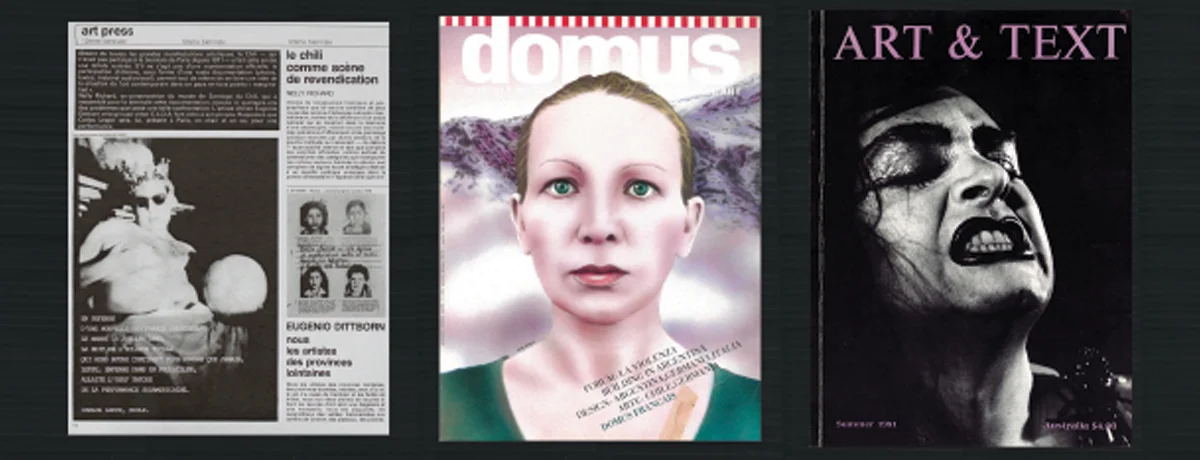
This talk explores Nelly Richard, a leading Latin American feminist curator and critic, and her use of magazines to circulate conceptual art during the dictatorship of General Augusto Pinochet (1973-1990). Working with her best friends, queer artists Carlos Leppe and Juan Dávila, Richard and her inner circle developed cover girls, curatorial interventions, artist pages, and foldouts in art magazines such as Domus and Art Press, as well as the erotic magazine Bravo. Operating in Pinochet’s crucible, dubbed the “petri dish” of neoliberalism in 1976 by the New York Times, they were navigating the epochal shift toward the free market that converted the body and persona into currency.
Their work with glossy magazines is linked to queer feminist art historical precedents and parallels such as Lynda Benglis’ 1974 intervention in Artforum, and Warhol’s centerfold for that same publication in 1982, Forged Images, both negotiating the economics of image making. But the affordances given to US-based artists to self-reflexively immerse themselves in commercial shine were not extended to Richard and her circle. To this day, their use of glossy magazines sits uncomfortably with preconceptions of what a leftist avant-garde operating under a Latin American military dictatorship should “look” like.
As Maria Berrios notes, the leftist, masculinist dogma of the region’s avant-garde often rejected the market outright. But for this queer feminist avant-garde, shining with commodity culture was not just a necessary part of the hustle, but opened up an alternative pose to resist Pinochet’s US-backed dictatorship.
Open to BC/CU ID holders, BCRW’s lunchtime lecture series offers scholars and writers an intimate space to discuss new works and works in progress with colleagues and students. Lunch from Home Sweet Harlem will be provided.
Verónica Tello is Assistant Professor of Modern and Contemporary Art History at Barnard College, Columbia University. She is completing a monograph that tracks the border-crossing circulation of Chilean conceptualism during the Cold War and the Pinochet dictatorship (1973-1990). Her book, Future Souths: Dialogues on Art, Place and History, offers a multi-vocal, global contemporary art history (Third Text Publications and Discipline, 2023). Her writings have appeared in Third Text, Memory Studies, Afterall, Frieze and Artforum.
Maja Horn is professor in the Department of Spanish and Latin American Cultures at Barnard College. Beforehand she was a research associate at FLACSO (Facultad Latinoamericana de Ciencias Sociales) in Santo Domingo, Dominican Republic, where she developed and taught a performance studies concentration (2005-2006). Her research focuses on Hispanophone Caribbean cultures with an emphasis on literature, visual and performance art, gender and sexuality studies, and political culture. Her book, Masculinity after Trujillo: The Politics of Gender in Dominican Literature (Florida UP, 2014), foregrounds the impact of U.S. imperialism on dominant notions of Dominican masculinity and their reinterpretation by pivotal Dominican writers, including Hilma Contreras, Marcio Veloz Maggiolo, Rita Indiana Hernández, and Junot Díaz. She is the editor of a special dossier for Small Axe: A Caribbean Journal of Criticism dedicated to the memory of José E. Muñoz (2015) and of a special dossier on “Critical Currents in Dominican Gender and Sexuality Studies” (2018). Maja published her second monograph Queer Genealogies in Dominican Literature and Culture in 2025. She is currently developing a new research project tentatively titled, “Beyond Independence and Inclusion: Disability Narratives in the Americas, a Critical South-North Dialogue,” that asks what other normative goals and aspirations must be included alongside “independence/autonomy” and “inclusion/accessibility” in disability advocacy and studies? She explores this question through a critical and comparative analysis of disability narratives from both North and South America, with a particular focus on personal narratives from people with disabilities and/or their caretakers.