
Sustaining Harlem: Art, Community Activism and Black Women’s Leadership from BCRW Videos on Vimeo.
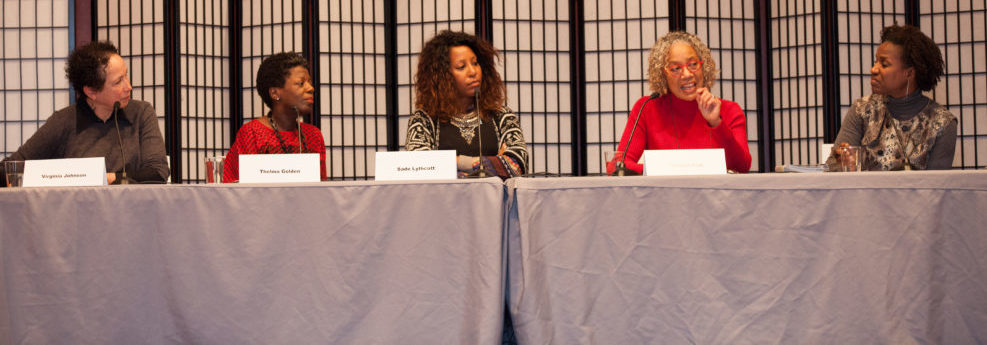
At this year’s Scholar and Feminist Conference, Sade Lythcott, Virginia Johnson, Pat Cruz, and Thelma Golden were invited to speak on the importance of art in considering the sustainability of Harlem as a community that centers Black cultural, political, and social innovation. As self-identified Black women, the speakers spoke to the centrality of their identities in imagining the futuristic impact of the cultural institutions they each represented. Pat Cruz, Executive Director of Harlem Stage, highlighted the reciprocal relationship between cultural institutions and the communities they serve and represent as crucial to the framework of sustainability.
Through mutual engagement and dynamic exchange, cultural institutions at their best are part of a dialogic set of engagements that extend beyond static locations and that challenge the bifurcation of art and everyday enactments of resistance. Cruz cited the Civil Rights Movement, to which three of the four represented institutions could trace their founding, as an example of social and political stimulus to the production of art. Virginia Johnson spoke of the ways in which the Harlem Renaissance fueled the creative energy that propelled art institutions like the Dance Theater of Harlem forward.
While they shift along with the ever-changing context of Harlem, these cultural centers exist on a historical continuum that acknowledges and honors the past while actively creating visions for futuristic advancement and present sustainability. In considering the meaning of community, Sade Lythcott draws a distinction between the physical spaces that neighborhoods occupy and the broader landscape of community, which is ever-expanding and untethered to a static location, reaching even the imaginary and metaphysical realms. For Lythcott, it is these unstable spaces that present sustainable potentials and possibilities for collectivization.
To look beyond the physical realm is to recognize the ways in which Black livelihoods are not entirely legible on the ideological parchment provided by a society that actively obliterates Black integrity. It is part of an effort to engage the shadow spaces where the Black imaginary thrives and lends itself to a subversive creative effort. All the women on the panel offered radical self-definitions of history, art, and community, centralizing the importance of creation as an articulation of sustainability.
http://www.tb-credit.ru/znk.html http://www.tb-credit.ru/kredit-online.html