
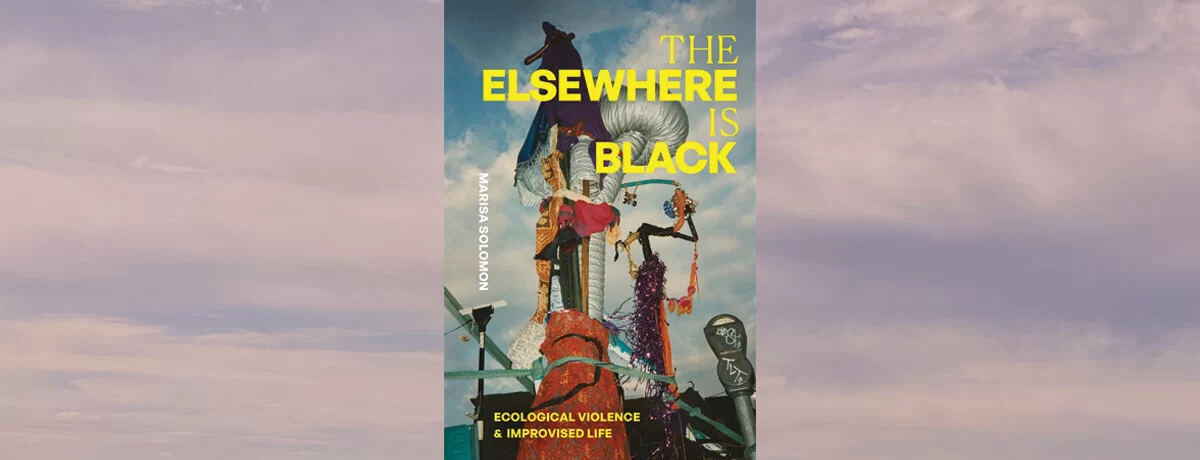
Barnard Assistant Professor of Women’s, Gender & Sexuality Studies Marisa Solomon’s new book, The Elsewhere Is Black, examines how waste is a mundane part of poor Black survival and a condition of settler colonial racial capitalism. Tracing the flow of trash and waste across Black spaces, from Brooklyn’s historically Black Bedford-Stuyvesant to the post-plantation towns of Virginia’s Tidewater, Solomon contends that waste infrastructures concentrate environmental risk in an elsewhere that is routinely Black. She theorizes the relationship between the devaluation of land and Black and more-than-human life to reveal how the risks of poisoning, police violence, dispossession, and poverty hold Black life captive. Moving back and forth between her time scavenging with Sal, a junk shop owner in Bed-Stuy—and his crew of scavengers Marty, Marvin, and Terran—and hanging out with a group of sex workers, Betty, Jane, and Mary, in Virginia Beach, Solomon foregrounds how people live and dream amidst waste’s daily accumulation.
Solomon sat down with her former student and BCRW Graduate Research Assistant Nico Wright (BC ’25) for a wide-ranging conversation about Black feminist method; the politics of (mis)naming; and the ways waste, gender, and property organize both environmental harm and collective survival.
— — —
Nico: I wanted to start at the beginning of your research, since in the book you talk about how this project began for you in grad school. What initially drew you towards waste as an object of research?
Marisa: In many ways, it begins where the book begins, which is when I was a kid. Immigrating to the US was difficult for my family. My grandmother worked tirelessly as a domestic worker, saving money to bring her children to the US. Unsurprisingly, we ended up in poor, inner city Black neighborhoods. For large chunks of my young life, we lived in the “hood.” While we moved around a lot, my mother was strategic and made sure that we lived in apartments districted for the “good” schools. School, however, made it clear that where we lived (me, my grandmother and extended family) was different from where my peers lived. It was the “bad neighborhood.” What made my neighborhood bad was unclear, other than that it wasn’t white or wealthy. The questions began there: “What actually distinguishes a good neighborhood from a bad neighborhood, or a good place from a bad place?”
In college, I got involved in the environmental movement. I worked for the People’s Potato at Concordia, a vegan food co-op, which was an amazing place where I was exposed to leftists and radical organizers who cared about the environment from all over the world. But even with this transnational cohort, from whom I learned so much, I realized that even the terms of the environmental work people were doing were colonial and/or white. Nothing about the kind of work that I got involved in—from tree planting to farmer’s markets—spoke to the terms of Black life, from urban poverty and precarity to immigration or my family’s life in the Caribbean. If I started when I was young with this question “what’s the difference between a good place and a bad place?” then in college I asked, “what is the environment if it is not also the environments where people of color live, work, play, breathe—in a word, survive?”
By the time that I got to grad school and had moved to Bed-Stuy, these longstanding questions started to coalesce. I was living across the street from the Marcy projects; a place that my white peers (and sometimes professors) seemed afraid of. The pathologized terms for Black places, “dirty”, “dangerous,” “crime-filled,” “disordered” became a nagging question: “why does a Black place mean disorder?” I wanted to unpack the elisions and realities.
But I also think you’re asking a more fine-grained question, which is why waste as an object? In the book, waste becomes many things over and over again. When I was in graduate school, the New Materialisms was all the rage in anthropology, which is what my doctoral degree is in. People interested in environmental questions were invested in de-centering the human by thinking about object oriented ontologies, human-object relations or human-animal relations. But, for those of us who are not centered (as human) politically, an analysis that ignores the thingification of the racialized/gendered “other” just reproduces colonial violence, this time through the priority of the “non-human.”
To me, waste is a perfect object to raise these philosophical problems and to point to the colonial and propertied assumptions in philosophy that are anti-Black and anti-Indigenous. Because waste is also material, its concentration follows the violence of settler colonial land-use practices. By tacking back and forth between how people use “waste” as description to inaugurate land value schemes and waste as an accumulation of devaluation, criminalization and ecological harm, waste reveals itself to be a condition or a set of social and material relations.
Nico: Totally. I agree that waste is never fully defined in the book, since it encompasses so many different things, but a major intervention in the book is establishing waste as a relationship rather than an object—as a condition of living, of being in dispossession, and not as a taken-for-granted fact of production. And it’s interesting that you bring anthropology and New Materialisms in because throughout the book, I was thinking a lot about that relationship between that field and how you mention its proximity to the plantation, the dominance of the visual, and its racial-colonial underpinnings in relation to Black feminist theory. You’re very attentive to method, particularly in resisting the urge to humanize or romanticize working-class, unhoused Black life. How do you think about the meeting point between anthropology and Black feminist theory in this project, and how do you navigate the tensions between them?
Marisa: One of the longstanding questions for Black feminist anthropologists is, “how does the method of field work change when informed by the subject position of the researcher and how does that make us think differently about the politics of research and writing?” I think one of the most important things that happened while I was writing was the recognition that even the feminist anthropology that I strove to emulate—where research is not merely extractive and writing is more collaborative—didn’t actually give me the tools to write about dispossessed Black people. And that’s primarily because there are so many places and people to whom one cannot return.
The chronic condition of dispossession meant that my interlocutors, my teachers, were always moving. “Return” itself assumes a kind of stability that is not afforded by living on the street. I often couldn’t “return” to my interlocutors; they often disappeared without notice. Sometimes that was by choice. (I hope). And I think it’s really important to hold out the possibility that people are moving, they’re producing opacity on purpose. (This is also a refusal that the researcher can return to them). But people are also moving because they’re being incarcerated and they’re being murdered. And this meant that ethnographically and theoretically I had to think about the conditions of disappearance that surround Black people’s lives. This is one of the ways that I lean heavily on the interdisciplinarity of Black feminism and Black studies.
Nico: I’m excited that you brought up opacity, especially because it connects to the blurry line between disidentifying with the terms of racial capitalism and becoming lost within its layers of meaning that mark Black life as waste, deviant, and subhuman. Like Spillers, you’re careful not to undermine the materiality of language in producing objects and subjects.
In chapter 3, “Revisions From Elsewhere,” you think about (mis)naming through the scene of a white woman crossing the street to run away from your group of scavengers in Bed-Stuy. I was struck by the way you yield the nuance of (mis)naming: how understanding why Black masculinity is construed as a threat to white women requires seeing Blackness as monstrous. Thinking also about the overdetermination of language and the liberal tendency to label all minority discourse as resistance (often in ways that romanticize dispossession), I’m interested in hearing more about how you theorized (mis)naming, particularly the relationship between language, opacity, and materiality.
Marisa: That question is a beautiful reading of my writing, but also a really thoughtful reading of my interlocutors and how they talk. One of the things I didn’t learn in my anthropological training was that as much as we learn that experience is subjective, that everything is socially constructed, that doesn’t necessarily give you the tools to write about the socially constructed nature of living.
Actually describing the social construction of the things that we are forced to adhere to, or forced to comport to and within, often doubles down on the use of violent descriptions. And as scholars we try to mitigate that violence, often using quotation marks to signify, “I don’t really believe this, it’s what the ideology looks like.” But at what point then are you just reproducing the accumulating violence that the academy already does? And that is where writing gets real complicated, real fast. Descriptions, scene setting, they’re politically motivated. I had to figure out how to simultaneously write around the racist descriptions of Black life and poor neighborhoods as waste and write differently about the conditions that waste produces.
One of the ways that Black studies is helpful here is in centering the creative histories through which Black people come up with new ways to talk to one another under duress, violent constraints and captivity. I recognized that in writing I was gonna have to lean into the way people reuse or recycle phrases, re-mix genres, as a strategy for surviving the ocular violence that anti-Blackness already perfects. Instead of drawing on the descriptions that outlets like the New York Times might use, I turned to other genres of Black cultural production, from hip hop to art to jazz, to the environmental sculpture on the cover of the book. Actually, that’s precisely what Black people do in refusing the way white supremacy misnames them. They constantly recombine what’s available to describe, to fabulate, to reconstitute community, to refuse the conditions under which they’re forced to live. The challenge to write differently (especially those last two chapters) is a gratitude-filled response to the generous offerings and lessons I learned from my interlocutors living on the street.
Nico: The way you bring up genres of being and genres of gender was very interesting to me. Gender and its relationship to ownership and the Atlantic slave trade emerges as a key analytic through which you theorize the violence of becoming human in relation to property. How did you theorize fugitive genders and dirty and trashy femme aesthetics as ecological practices?
Marisa: White cis-heteropatriarchal genders are normative positions (or relations) in the regime of property accumulation. Under racial capitalism, those normative genders position you as the subject of class transmission. They are part of the heteronormative racial project to pass down property over generations. But being outside of the inheritance of property marks you for the inheritance of dispossession and a gendered relationship to it. One of the things I am trying to make clear is that dispossession is not only a lack (of property), dispossession is the structural inheritance of the harms that accumulate because of property.
Sites of dispossession (or dis-accumulation) are not merely lack, they are also real places where things accumulate like waste, police violence and ecological harm. They are places that people inhabit with sounds and textures and cultures of resistance. What does it mean to create a gender out of those material conditions, those toxic conditions displaced elsewhere? What does it mean to create a gender out of toxicity, trash and risk? Are there different kinds of gendered relations located in that textured Black living and gender non-conforming modes of existence? Part of what I hope readers take away from this part of the analysis is that there are other genres of gender “elsewhere.” And those genders may not always be trans, but they are not all cis either.
“Trashy” as a genre of living, then, names one of the ways that Black women on the street make life, kin, and community in dispossession. It is a way of naming the not so straight and not so cis ways that non-propertied living requires an improvisational relationship to gender and survival. I see trashy aesthetics as speaking against—or speaking back to—the code of heteropatriarchal propriety that is required of property. Trashiness doesn’t seek to distance oneself from the materiality of dispossession; instead it insists on the actual messiness of what it means to live on the street. For me, the practices of self and community elaboration that Black people forge under these toxic conditions of risk violence and harm are an ecological achievement. I see the non-normative genres of gender as part of the self and community practices that keep people alive, a kind of environmentalism that de-centers both property and respectable propriety. If property is a relationship to gender, then so is not being able to have property.
Nico: Or being property.
Marisa: Or being property precisely, which is where this Spillers-ian, I guess you would say, lineage to the work comes in. I think it’s important to recognize that it really is under the accumulated material violence of false names that Black women have to somehow name themselves. What I learned from my interlocutors is one way to negotiate this is by constantly reusing misnames (e.g. calling yourself trashy) as itself a fugitive project.
To be clear, I’m not saying that anyone can just misname themselves and it’s “fugitive.” These misnames are disfigured representations of Black women surviving the environmental harms of settler colonialism and racial capitalism. “Reuse” here, points to the way that people take hold of lies (that Black people are pathologically wasteful/filled) and bend them to re-member something true (that people make life with/in the toxic and waste-filled conditions of dispossession).
Nico: That turn to gender and the other side of the elsewhere that you offer emerges from Black femme lines of flight that are, as you say, framed by racial capitalism and yet are ultimately subversive to its project.
Marisa: I appreciate that you used the word subversive because part of the goal of the title of the book The Elsewhere Is Black is to insist that modes of life that subvert settler racial capitalism don’t come from the “clean” and “white” spaces of property relations. We need to better attend to the material conditions through which people forge resistance. More often than not, they are the places where multiple forms of harm pool. The places of acute environmental harm, which are created (and stolen) by the colonial infrastructures that support capitalist value production and maintain property as a mode of life, are real places. They are places that property pretends doesn’t exist or only pathologizes as criminal. These so-called criminal elsewheres of concentrated violence, of dispossession, of police brutality, and slow and quick death are the environmental conditions under which multiple forms of resistance are forged. I think sometimes the links between environmental devastation and other forms of domination get disarticulated and this narrows what counts as “environmental” and what counts as “environmentalism” or ecological practice.
Nico: When you went to Virginia, you were trying to get into these waste plants, and you quickly realized that this was impossible. In that moment of disorientation, you encountered Betty and the other sex workers at the motel, which redirected you toward a very different set of questions. Did that unexpected meeting shift your argument at all, and can you recall any specific stories, moments, or conversations with your interlocutors that really transformed the path you were going on?
Marisa: There’s no question that the sex workers changed the story. When I went to Virginia, I was looking for New York City’s trash. In being there I had to confront that I, too, was looking for something pathological, not about people of color, but about waste infrastructures. When the sex workers in the book say, “baby, you’ve found it” meaning they are, they know, and they inhabit the landscapes of the trash that I’d been looking for, I realized that I needed to attend to the conditions under which things disappear. I had to ask myself, when does trash seem to “appear” and disappear? What are the spatial relations, land-use politics, relations of domination that make waste both a fact and a fiction? In many ways, going to Virginia forced me to reflect on things I could not see, or could only see if I scaled up to the geography of regions, Black migrations routes, or flows created by waste company contracts. What these sex workers forced me to realize was that there is nothing pathological about colonial waste infrastructures; they work as intended.
I wrote the book the way I wrote it for many reasons, including because I felt like I owed it to my interlocutors. I had (and have) many misgivings about writing a book where I am adding another “case” study to the litany of violences done to Black people. But I kept thinking about the conversations I had with sex workers who would say, “Baby, we don’t care. Just make sure that we look fly as fuck.” I wrote the book, especially for the girls, because they wanted to be represented and seen; and I wrote inspired by what they taught me and guided by the promise that I would do everything I could to honor how they wanted to be represented.
Nico: The part about yourself and your relation to them is so present. I don’t think it’s a matter of either losing yourself and your positionality in it, because your identity as a Black queer woman mediates the spaces you can enter and the conversations that become possible. I kept thinking about the pleasures and challenges of writing from that space of vulnerability and relationality, especially as you move into the last chapter, where you hold together so much life and so much violence while refusing to give readers or anyone a single answer or a single view of it.
Marisa: Thank you for this. And, I think it’s important to recognize that people also invited me in. It’s not only that I made space or my positionality mediates space, but they made space for me, including as kin. It was truly an honor to be invited into the living rooms created with waste objects in a parking lot. Hanging out with a bunch of girls doing some drugs before they would get ready to go trick is a fucking honor. And they taught me more than I can say thank you for. They really did.
You’ll notice that the book starts in the South, not New York, even though I live in and did ethnographic fieldwork in New York. This is because I realized that when people encountered my work and New York came first, they would stop reading or they wouldn’t ask questions about Virginia. I refuse to let the girls not be known, so I started flipping the story. It was incredibly productive. Starting in the South was a centering of Black women but it was also a way of saying, don’t get it twisted, the logics that underpin this story start with the plantation. This, I hope, asks the reader who lives in New York City to re-situate “the city” as stolen land and as always shaped by the way anti-Blackness is a land use strategy in this settler colony we call the United States.
The last thing I’ll say is the girls would often say “we don’t talk about the environment.” And this was very familiar to me. When you associate “being environmental” with being white, cis, and land-owning, what does it mean to be Black and talk about the environment? But of course, if you frame the question slightly differently, a litany of stories about the environment emerges, including about toxicity in their homes, lack of waste infrastructure, lead poisoning, etc. It forced me to reckon with just how ordinary toxification is to Black life. Of course, I already knew this from my own experience. I knew it because I grew up with it. But, like I said before, I was still looking for some “proof,” or some smoking gun that unequivocally proved that waste infrastructures, their planning, or the regulations set forth by the EPA [United States Environmental Protection Agency] were covering up egregious environmental crimes. But that’s not the story. The story is: the toxification of Black life is so thoroughly ordinary, the violence is mundane. And that’s what I had to figure out how to say.
Nico: I agree, because as you historicize the development of these waste infrastructures that have enabled the flow of New York City’s trash to Virginia since 1997, you show how the privatization of the waste industry determines where toxic capture is most profitable and where waste as a commodity is accumulated. All of it is violence and it is right there in your face.
Marisa: And what’s remarkable is the accumulation is normal. It is so ordinary. It’s just so basic.
Nico: In the first part of the book you show how your interlocutors don’t see themselves as “knowing” about the environment or having any sort of environmental politics, and yet as they speak, they are theorizing themselves and it is embodied theory. They’re talking about chronic pain and their houses sinking, and it is these small things that emerge as mundane and as a condition of Black life. I love the way you mobilized an elsewhere that is not distant but immediate—an elsewhere that is here, now, and densely populated.
For my last question, I’m thinking about the scene where you’re scavenging in the abandoned apartment, and Sal finds the picture book. You write about how that attention—this tending to objects—makes Black lives matter, and how storytelling, in its speculative capacity, is a Black ecological practice. I am thinking about that in relation to the recent turn toward the archives, both inside and outside institutions, amidst the intensifying violence being inflicted on Black and brown people globally. People are returning to these spaces not as a way of giving up, but as a way of reminding ourselves that there was, and is, something there.
Where do you place grief work, storytelling, and particularly non-institutional memory work in radical politics today? And what kinds of solidarities emerge from these practices as part of a Black ecological politics?
Marisa: One of the things that I realized doing this work is that so many of our supposedly lefty environmental projects—and I’m very much thinking alongside Max Liboiron’s work in Pollution is Colonialism here—presume access to the land. And that presumption re-encodes colonial practices, from the method of environmental projects to the goal of environmental projects. They are not in conversation with the Land Back Movement and are not aligned with Indigenous liberation. Often, these projects, such as the Zero Waste movement, still presume the settlers access and more importantly, control over, what land should be used for. We can even see this in the ways that land use is evaluated, land value is measured and the categories through which land is described, i.e. property.
In my research, Marty, Marvin, Terran, Sal, Betty, Mary, Jane and others engage in life-ways that keep precarious people alive without centering land ownership or property as Black liberation. Black people precariously housed on the street are trying to keep each other alive; ain’t nobody invested in ownership. They literally cannot afford to be. While my interlocutors might not articulate these methods of survival as in solidarity with Indigenous sovereignty, these alternative life-ways—which include the creative use of waste to make spaces of pleasure—refuse property and heteronormativity as the settler colonial promise. Perhaps these lifeways are a methods of deviant, non-respectable and decolonial stewardship that could be organized in service of Black and Indigenous liberation.
I’m struggling a bit with this question of non-institutional memory work in radical politics because the university is so good at capturing radical politics. I am more terrified than I’ve ever been of the power of elite capture and its ability to wrench transformative methods out of the conditions from which it arose, and moreover, to use those methods (of struggle and community building) to repress, disappear and kill others. The university has always been extractive. Its capacity to extract resources to survive its own demise—by stealing from and then repressing social movements—are things that have only become clearer over the last few years. Part of what that means is we need to be really careful with the stories that we share with the university, myself included.
I really am at a loss for what that means or what that mobilizes, but what I do know is that storytelling is something that can’t actually be taken away. Stories can be repressed, they can be violently sanctioned, yes. But our capacity to tell, make, share, remember and re-member stories can never be taken away. It’s one of the few things that I know we can all hold onto.
Nico: That’s so beautiful. The university, as part of a national project, has been tasked with telling particular stories in order to justify and reproduce racial-colonial regimes of accumulation. What stays with me about your storytelling (and the storytelling of your interlocutors), is the way it offers a form of remembering that holds the impossibility of return, while still insisting on the creation of other spaces and elsewheres, even as it accepts that they can never be the same
Marisa: Yeah, no, exactly. They won’t be the same. But we can always use whatever is at our disposal to re-member.
Nico: And that’s the beauty of it.
— — —
Marisa Solomon is an Assistant Professor of Women’s, Gender and Sexuality Studies at Barnard College, Columbia University, where she teaches courses in feminist intersectional science studies, abolitionist ecologies, Black geographies, feminist theory and queer of color critique. Her new book, The Elsewhere is Black: Ecological Violence and Improvised Life (Duke University Press 2025), which received Duke University Press’s Scholar of Color First Book Award, considers ecological politics from the position of criminalized Black dispossession. In so doing, The Elsewhere Is Black examines how waste is a mundane part of poor Black survival and a condition of settler colonial racial capitalism in the U.S. Locating Black survival as a site from which alternative eco-political imaginations spring, she foregrounds how people live and dream amidst waste’s daily accumulation. Solomon opens new ecological horizons to ask: What forms of environmentalism emerge when Black un/freedom has never been distant from waste?
Nico Wright is a recent Barnard graduate and a Graduate Research Assistant at The Barnard Center for Research on Women. They recall deciding to major in Women’s, Gender & Sexuality Studies after the first day of Professor Solomon’s “Critical Approaches in Social and Cultural Theory” course during their first semester of college. At BCRW, Nico has been working on developing a narrative history of the Scholar and Feminist conference through archival materials and collaborating with BCRW staff to plan the 50th annual conference. Their interest in archival, memory, and storytelling work characterizes their scholarly research, which has focused on the temporal practices of solidarity embodied by anti-imperial organizing networks.