
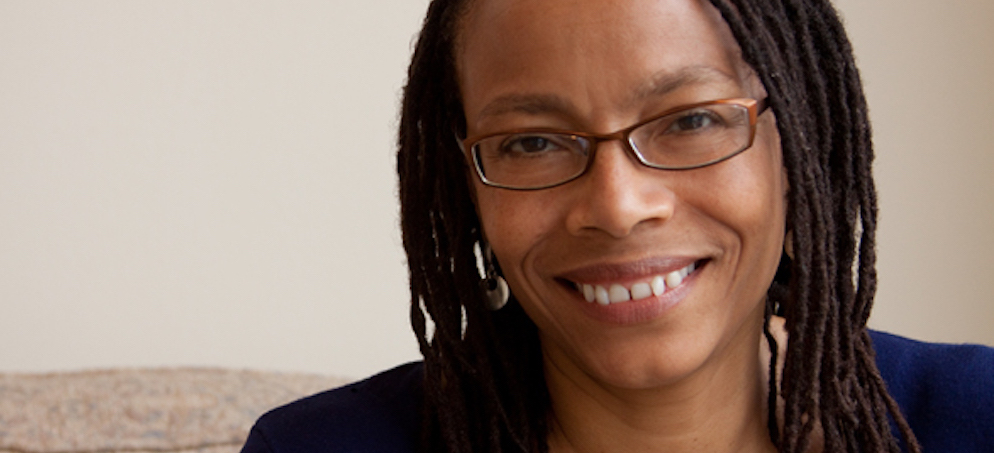
Race, Gender, and the New Biocitizen video is now available on the BCRW website.
“We’re going to start by defining some of the terms that Roberts uses in her book,” I said to a class of my peers last week, “let’s begin with ‘biological race’.”
My Critical Race Theory class was discussing Fatal Invention: How Science, Politics, and Big Business Re-Create Race in the Twenty-first Century by Dorothy Roberts, the BCRW’s guest lecturerduring that same week. Everyone was eager to chime in – jumping over one another to speak about all the points they had learned from the book and from her lecture the night before about everything from Tay-Sach’s disease to reproductive tourism.

In the book, Dorothy Roberts knits these examples together to argue that race has not only been created by science in the past, but re-engineered and abused by the same system. She makes the claim that scientific objectivity with regards to race actually masks a fundamentally social issue: if race is a social construction, how can scientists use self-reported race as an independent variable when assessing differences between groups? The question, answered through a combination of critiques on genetic/genomic science and an examination of the political usefulness of race, gave us the underlying structure for our own discussion in class. At that point, summaries failed me.
At the lecture, Roberts talked about how hard it is to challenge our notions of science and to distill it all into an hour-long talk. Her argument is clear-cut and illustrated well by the points she makes about genetic testing, ancestry, and the essentialization of race. The challenge for the reader, however, is to wrap their head around the idea that race isn’t biological – that it’s component parts as laid out by scientific study do not make up the whole. This is not on the part of the author; rather, it is the struggle of challenging a worldview that has been so deeply ingrained into our understanding of race as a categorization, that even those who study it are forced to look critically at their own assumptions.
http://www.tb-credit.ru/get.html http://www.tb-credit.ru/zaimy-na-kartu.html