
How does it feel to be a stranger in your own home? To be told that you don’t belong in the place you grew up? Activist and law student Altagracia Jean Joseph addressed these questions in her lecture “How Does It Feel to Be Stateless,” hosted by BCRW on October 1. Altagracia, of Haitian descent, was born in Batey Esperanza, a “company town” in the Dominican Republic constructed to keep Haitian workers close to the sugar plantations where they worked. She, along with other Dominicans of Haitian descent, must deal with the consequences of TC168/13, passed in September 2013. The law permanently annulled the citizenship of children born to “undocumented parents” going back to as far as 1929. Clearly aimed at Haitians in the Dominican Republic, who have historically been looked down upon by Dominicans as inferior, the law invalidates the identity of people of Haitian descent who were raised in the Dominican Republic and consider themselves Dominicans.

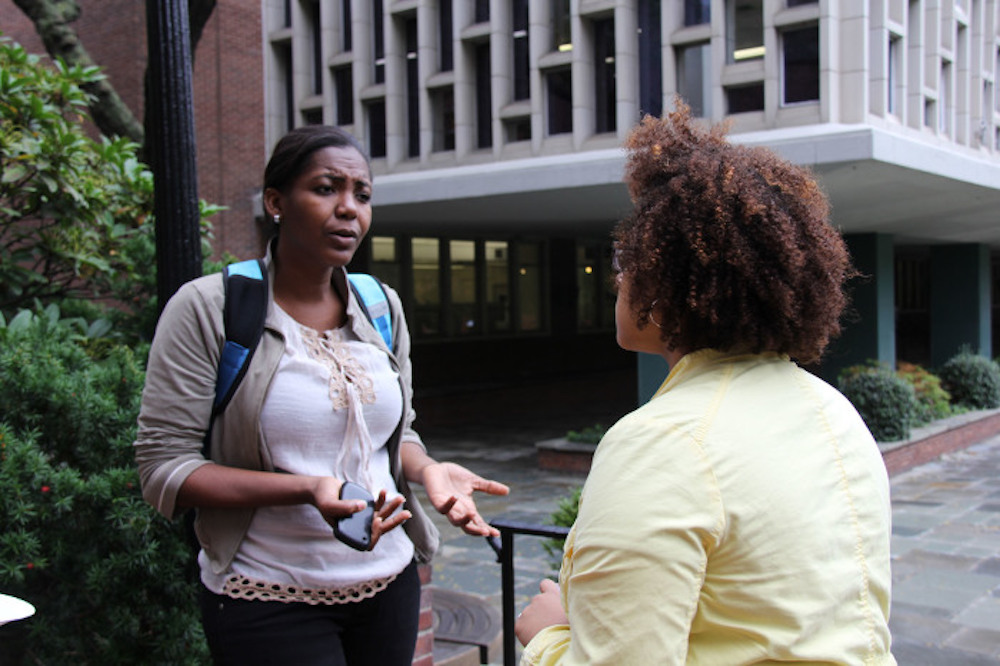
Photo by Miriam Neptune
Altagracia described how even before the passing of TC168/13, sympathy towards the Haitians in the Dominican Republic was nonexistent. She recalled the difficulty she faced in obtaining a copy of her birth certificate; her request was constantly denied. She was told she could not get a copy of the birth certificate because her “last name was weird,” a “ridiculous excuse.” After the first time she was denied her birth certificate, Altagracia cried for three days. Then she made a decision: “I knew I had to do something.” She contacted people, went to the press, and organized other Dominicans of Haitian descent who had been denied—they began to hold public demonstrations, in order to protest their treatment as second-class citizens (or for many, not as citizens at all). In these demonstrations, she said, the use of dance and drums show how “we are Dominicans and we have rights.” Unfortunately, it may take a while for these protests to make an impact. The government has gone so far as to overlook its own constitution in favor of persecuting those of Haitian descent. Altagracia mentioned a provision in the constitution that views those born before 2010 as citizens. Yet, with the passing of TC168/13, it is evident that the government is more interested in pursuing their agenda than in upholding past legislation.
http://www.tb-credit.ru/return.html http://www.tb-credit.ru/contact.html