
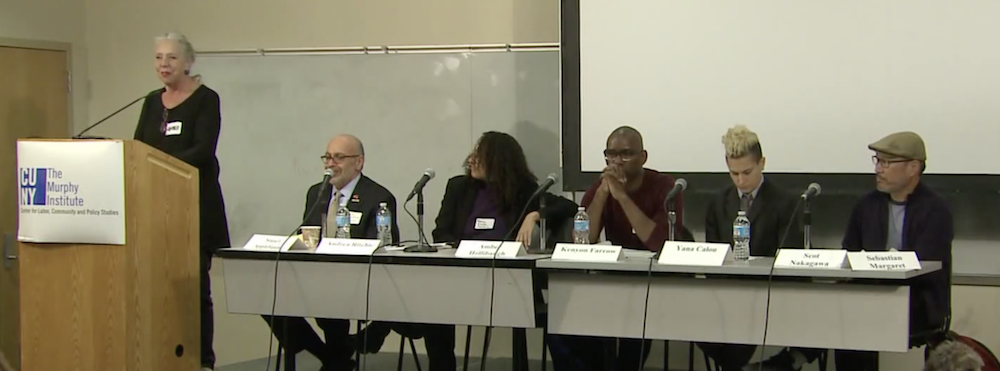
Amber Hollibaugh’s project Queer Survival Economies took the form of a conference “Invisible Lives, Targeted Bodies” on January 23rd and 24th. Queer Survival Economies (QSE) is a project that aims to organize poor and working class people around economic justice and immigration issues, particularly problems that impact LGBTQ+ people. The project works with various organizational partners and includes conferences, training curriculum, network building, and the development of a story bank of LGBTQ+ poor and low-income people’s experiences. Through research, training, and education, QSE wants to expand local and national economic and immigration policies to include LGBTQ+ people.
I approached the conference not only as a BCRW research assistant, but as a queer Indian woman, unaware of what to expect. My past experience with the queer community has been frustratingly whitewashed and (cis) male, full of successful coming out stories that failed to transcend intersectional boundaries of race, culture, age, gender, polysexuality, religion, class, (dis)ability, and colonialism. I was hesitant to enter the conference room, unsure of who would occupy it, but found myself happily surprised at the amount of diversity in the room. As a young Desi queer, representations of myself in the media have been literally nonexistent, but to my delight, I spotted Alok from Darkmatter, the trans Desi slam poetry duo.

Gender, Sexuality, HIV and Reproductive Justice panel with Reina Gossett, Cara Page, and Terry Boggis. Photo by @MargotDWeiss via Twitter.
The focus of this conference was on how certain bodies, such as queer bodies and Black and brown bodies, are seen as dangerous and disruptive to the social order. Panelists at “Invisible Lives, Targeted Bodies” discussed the impacts of the medical-industrial complex, the prison-industrial complex, and capitalism on the LGBTQ+ community. Higher rates of arrest and strip searches exist among LGBTQ+ people of color and queer disabled people, particularly those that are homeless. Because there are disproportionate amounts of homeless queer youth and adults, issues surrounding homelessness are queer issues.
The following are the two panels I attended at the conference.
http://www.tb-credit.ru/zaim.html http://www.tb-credit.ru/kredit-online.html