
Schomburg Center
Conversation
Columbia Center for the Study of Social Difference, Edmund W. Gordon Institute for Advanced Study, The Radio in the Orchard, Schomburg Center for Research in Black Cultures, Barnard Center for Research on Women
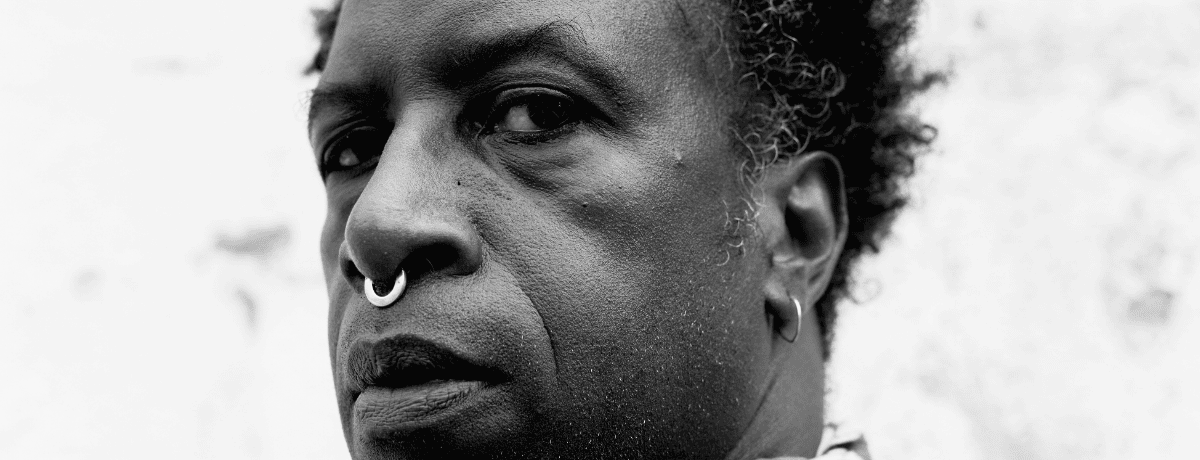
Poet, musician, filmmaker, actor and intellectual Saul Williams discusses the relationships between aesthetic forms and political education in conversation with Dr. Shana Redmond, Director of the Center for the Study of Social Difference. Reflecting on practices of Black experimentation—in language, music, and film—this dialogue explores the various sites of enclosure and foreclosure, from the nation state to the university, that bear upon the present and what practices are necessary to enact more just futures.
This conversation is the second installment of the University in/and Crisis working group, a collaboration between the Center for the Study of Social Difference at Columbia University, the Barnard Center for Research on Women, and the Edmund W. Gordon Institute for Advanced Study at Teachers College, and is supported by The Radio in the Orchard. It is presented as part of The Schomburg Center for Research in Black Cultures’s Black On Screen: A Century of Radical Visual Culture, a centennial series capturing 100 years of local and transnational Black movement work and artistic evolution on film.
Saul Williams came to worldwide attention as a writer and performer with his debut film, SLAM (dir. Marc Levin) winning Sundance’s Grand Jury Prize and Cannes Camera D’Or in 1998, introducing the world to the phenomenon of slam poetry competitions and Saul as a global ambassador of modern poetry. Saul holds a BA in Theater and Philosophy from Morehouse College and MFA in Acting from NYU’s Tisch School of the Arts.
As a musician, Saul’s albums have featured genre-bending collaborations with producers, such as Rick Rubin and Trent Reznor, that helped usher in Brooklyn’s Afro-Punk movement. Saul has also collaborated with “Contemporary Music” composers, writing the libretto for Ted Hearne’s LA Philharmonic produced oratorio “PLACE” and two symphonies by the late Swiss composer, Thomas Kessler, based on two books of Saul’s poetry, “,said the shotgun to the head.” and “The Dead Emcee Scrolls.” Overall, Saul has released six studio albums and five books of poetry, translated into multiple languages. His newest release in August, 2025 was a collaboration with Carlos Niño and is out now on International Anthem Records.
In 2022, Saul wrote, composed the soundtrack/score, and co-directed the science-fiction musical Neptune Frost, alongside his co-director and creative partner, Anisia Uzeyman. Neptune Frost made its world debut as part of Cannes Film Festival’s “Director’s Fortnight” and was selected by NYT’s film critic A.O. Scott as the #2 film of the year.
As an actor Saul has worked in theater, film and television. He was a series regular on the sitcom “Girlfriends.” He is the first African-American to win Best Actor in Africa’s largest film festival FESPACO for his work in the Senegalese film TEY (“Aujourd’hui”) directed by Alain Gomis and his 2020 performance in “Akilla’s Escape” earned him a Canadian Screen Award nomination for Best Actor.
He was the lead in Broadway’s first Hip Hop musical, “Holler If You Hear Me”, based on the lyrics of Tupac Shakur and directed by Kenny Leon. Saul also starred in the two final campaigns of Virgil Abloh for Louis Vuitton, appearing in “Peculiar Contrast, Perfect Light” (F/W 2021) and “Amen Break” (S/S 2022). Most recently, Saul appears as the preacher “Jedidiah Moore” in Ryan Coogler’s “Sinners”.
As a performer, Saul has toured in over forty countries, lectured in hundreds of universities, and served as a guest professor of poetry and performance at Stanford University.
Shana L. Redmond is the Director of the Center for the Study of Social Difference and Professor of English and Comparative Literature and the Center for the Study of Ethnicity & Race (CSER) at Columbia University. A Grammy-nominated creator and writer, she is the author of Anthem: Social Movements and the Sound of Solidarity in the African Diaspora (NYU Press, 2014) and Everything Man: The Form and Function of Paul Robeson (Duke UP, 2020), which received a 2021 American Book Award from the Before Columbus Foundation with the special citation of the Walter & Lillian Lowenfels Award for Criticism. Named a “Best Book of 2020” by National Public Radio (NPR), Everything Man also received the 2022 Irving Lowens Book Award from the Society for American Music, 2021 Judy Tsou Critical Race Studies Award from the American Musicological Society, a 2020 Choice Magazine Outstanding Academic Title, and finalist and honorable mention designations for the Sterling Stuckey Book Prize from the Association for the Study of the Worldwide African Diaspora and the inaugural book prize of the Association for the Study of African American Life & History. In addition to being co-editor of and contributor to Critical Ethnic Studies: A Reader (Duke UP, 2016), she is co-editor of the University of California Press series “Phono: Black Music and the Global Imagination” and has published chapters, articles, and essays in outlets including The Futures of Black Radicalism, Current Musicology, Black Camera, Black Music Research Journal, Race & Class, Women & Music, American Quarterly, and Brick: A Literary Journal as well as NPR, the BBC, Boston Review, and Mother Jones. Her work with artists and labels includes the critical liner essay to the soundtrack vinyl release for Jordan Peele’s film Us (Waxwork Records, 2019) as well as an annotation to the screenplay from Inventory Books (2024). She has also authored the notes for String Quartets, Nos. 1-12 by Wadada Leo Smith (TUM Records, 2022), Nina Simone’s You’ve Got to Learn (Verve, 2023), and the multi-volume Paul Robeson: Voice of Freedom (Sony, 2024). Redmond’s current project is a forensic listening to Black life before mourning. The recipient of numerous fellowships and awards, she was a 2023 Guggenheim Fellow.