The Scholar and Feminist: Fifty Years of Meeting the Moment
SHARE YOUR PHOTOS!
Upload your conference photos to the collective S&F 50 archive.
Description Program Program Zine Accessibility Bios FAQs Keynote Livestream
REGISTRATION HAS REACHED CAPACITY.
See registration update message at the end of this page.
Description
Featuring: Lila Abu-Lughod, Zahra Ali, Sa’ed Atshan, Elizabeth Bernstein, Abigail Boggs, Judith Butler, Leslie Calman, Tina Campt, Elizabeth Castelli, Edwidge Danticat, Lisa Duggan, Alexis Pauline Gumbs, Jack Halberstam, Saidiya Hartman, Janet Jakobsen, Rebecca Jordan-Young, Temma Kaplan, Margot Kotler, Greta LaFleur, Sophie Lewis, Nick Mitchell, Manijeh Moradian, Amber Musser, Premilla Nadasen, Anupama Rao, Toshi Reagon and BIGLovely, Catherine Sameh, Evren Savci, C. Riley Snorton, Thenmozhi Soundararajan, Catharine R. Stimpson, Neferti Tadiar, Maya Wind, and Jacqueline Woodson.
Friday, February 27, 2026, 10am – 7pm
& Saturday, February 28, 2026, 10am – 6:30pm
See detailed program information below.
For half of a century, The Scholar and Feminist Conference has provided a mutually galvanizing space for scholars, activists, and artists to confront the most pressing issues at any given moment. Defining scholarship as for action from the very beginning, the conference has with unflagging regularity “met the moment” with intersectional feminist knowledge to inspire and build a robust response to contemporary crises. In many ways, the conference has grown up alongside academic feminism itself, yet, rather than uncritically mirror this history, it has consistently pushed back against feminism’s institutionalization. The conference highlights provocations, controversies, foundational gaps, and struggles that both cement its field-forming position and trouble a feminist progress narrative.
The conference’s history of meeting the moment with a vigorous feminist response provides a toolkit for understanding the present. This year, it asks: what are feminist responses to the global rise of authoritarianism and fascism, white Christian nationalism, ethnic cleansing and colonial violence, attacks on higher education and academic freedom, and assaults on queer and trans rights? Which practices of solidarity and feminist arts of transformation can mobilize resistance, provide sustenance, and produce social change? What can we learn from moments in our past, and how do they serve as a springboard for action today?
Image Credit: Miriam Klein Stahl
Program
FRIDAY, FEBRUARY 27
All panels are located in the Event Oval in the Diana Center unless otherwise noted.
10:00 am | Welcome by Rebecca Jordan-Young (Director, Barnard Center for Research on Women and Ann Whitney Olin Professor of Women’s, Gender, & Sexuality Studies, Barnard College) and Margot Kotler (Senior Associate Director, Barnard Center for Research on Women)
10:30 am – 12:00 pm | Meeting the Moment: BCRW Directors on Defending Feminist Knowledge
- Leslie Calman (Director, Barnard Center for Research on Women, 1992-1998)
- Elizabeth Castelli (Professor of Religion, Barnard College)
- Janet Jakobsen (Claire Tow Professor of Women’s, Gender, and Sexuality Studies, Barnard College)
- Temma Kaplan (Distinguished Professor Emerita of History, Rutgers)
- Premilla Nadasen (Ann Whitney Olin Professor of History, Barnard College)
- Catharine R. Stimpson (Professor Emerita, NYU)
- Moderated by Rebecca Jordan-Young (Director, Barnard Center for Research on Women and Ann Whitney Olin Professor of Women’s, Gender, & Sexuality Studies, Barnard College)
12:00 pm – 1:15 pm | Lunch: Celebrating 50 Years of Feminist Scholarship and Action
- Introductory remarks by Jean Howard (George Delacorte Professor Emerita in the
Humanities, Columbia University)
1:15 pm – 1:30 pm | Welcome Remarks by Rebecca Walkowitz, Provost and Dean of the Faculty
1:30 pm – 3:00 pm | Protectionist Feminism and its Legacies: From the Sex Wars to Carceral Feminism
- Lila Abu-Lughod (Joseph L. Buttenwieser Professor of Social Science, Columbia University)
- Lisa Duggan (Professor Emerita of Social and Cultural Analysis, New York University)
- Greta LaFleur (Associate Professor of American Studies and Women’s, Gender, and Sexuality Studies, Yale University)
- Sophie Lewis (Visiting Scholar, Center for Research in Feminist, Queer and Transgender Studies, University of Pennsylvania)
- Amber Musser (Professor of English, Black, Race, and Ethnic Studies, Africana Studies, The Graduate Center, CUNY)
- Moderated by Elizabeth Bernstein (Professor of Women’s, Gender & Sexuality Studies and Sociology, Barnard College)
3:15 pm – 4:45 pm | The University in/and Crisis
- Abigail Boggs (Assistant Professor, Sociology, Feminist, Gender, and Sexuality Studies, and Education Studies, Wesleyan University)
- Nick Mitchell (Associate Professor, Department of Feminist Studies and the Program in Critical Race and Ethnic Studies, UC Santa Cruz)
- Maya Wind (Postdoctoral Fellow, Black Studies, UC Riverside)
- Thenmozhi Soundararajan (Founder, Equality Labs)
- Moderated by Anupama Rao (Professor of History and MESAAS, Barnard College) and C. Riley Snorton (Professor of English and Comparative Literature and ISSG, Columbia University)
4:45 pm – 5:45 pm | Reception (James Room, 4th Floor, Barnard Hall)
5:45 pm – 7:00 pm | Performance: Toshi Reagon and BIGLovely (Lower Level Theater, Barnard Hall)
————————————————————————————————
SATURDAY, FEBRUARY 28
10:00 am | Welcome by Rebecca Jordan-Young (Director, Barnard Center for Research on Women and Ann Whitney Olin Professor of Women’s, Gender, & Sexuality Studies, Barnard College)
10:30 am – 12:00 pm | Transnational Feminist Perspectives on Survival, Solidarity, and Transformation
- Zahra Ali (Associate Professor of Sociology and Anthropology, Rutgers University – Newark)
- Sa’ed Atshan (Associate Professor of Peace and Conflict Studies and Anthropology, Swarthmore College)
- Catherine Sameh (Associate Professor of Gender and Sexuality Studies, UC Irvine)
- Evren Savci (Assistant Professor of Women’s, Gender, and Sexuality Studies, Yale University)
- Neferti X. M. Tadiar (Professor of Women’s, Gender & Sexuality Studies, Barnard College)
- Moderated by Manijeh Moradian (Assistant Professor of Women’s Gender, & Sexuality Studies, Barnard College)
12:00 pm – 1:30 pm | Lunch
1:30 pm – 3:00 pm | How We Write Black Feminism Now
- Tina Campt (Roger S. Berlind ’52 Professor of Humanities, Princeton University)
- Edwidge Danticat (Wun Tsun Tam Mellon Professor of the Humanities in the Department of African American and African Diaspora Studies, Columbia University)
- Saidiya Hartman (University Professor of English and Comparative Literature, Columbia University)
- Jacqueline Woodson (Writer)
- Moderated by Alexis Pauline Gumbs (Poet, independent scholar, and activist)
3:15 pm – 4:45 pm | Authoritarian Phantasms and a Radical Counter-Imaginary
Keynote by Judith Butler
(Distinguished Professor in the Graduate School, UC Berkeley)
With an introduction by Jack Halberstam (Professor of Gender Studies and English, Columbia University)
5:00 pm – 6:30 pm | Reception (James Room, 4th Floor, Barnard Hall)
Keynote Livestream
Authoritarian Phantasms and a Radical Counter-Imaginary
Keynote by Judith Butler
With an introduction by Jack Halberstam
Saturday, February 28, 3:15 pm – 4:45 pm
Program Zine
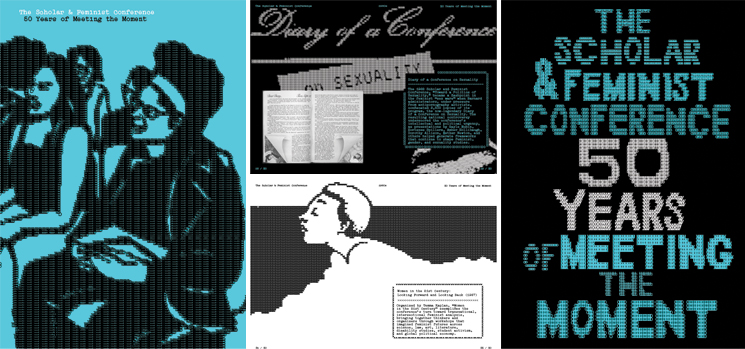
This year’s program (PDF) was designed by the zinemaker Neta Bomani and printed on a risograph printer as an intentional nod to the feminist print cultures that shaped the conference’s early years.
Accessibility
Live ASL interpretation will be provided by Brandon Kazen-Maddox of Body Language Productions and DB-TIP (DeafBlind Training, Interpreting and Professional Development). For additional accessibility needs, please email bcrw@barnard.edu.
This conference is free and open to the public. Registration is required.
Bios
Lila Abu-Lughod is the Joseph L. Buttenwieser Professor of Social Science at Columbia University where she teaches anthropology and gender studies. A leading voice in the debates about culture, gender, Islam, and global feminist politics, her award-winning books include Veiled Sentiments: Honor and Poetry in a Bedouin Society; Writing Women’s Worlds: Bedouin Stories; Dramas of Nationhood: The Politics of Television in Egypt; Nakba: Palestine, 1948, and the Claims of Memory; and Do Muslim Women Need Saving? She is a former director of the Institute for Research on Women, Gender, and Sexuality; the Middle East Institute; and the Center for the Study of Social Difference. Her latest book is The Cunning of Gender Violence: Geopolitics and Feminism (Duke University Press 2023) co-edited with Rema Hammami and Nadera Shalhoub-Kevorkian out of a collaborative international project on “Religion and the Global Framing of Gender Violence” supported by the Henry Luce Foundation and housed at the Center for the Study of Social Difference at Columbia University.
Zahra Ali is a writer, a feminist, an associate professor of sociology at Rutgers University-Newark, and the founder of Critical Studies of Iraq, an initiative dedicated to centering the work of scholars, feminists, and activists in Iraq. Her research explores issues of women and gender, race and class, social and political movements in relation to islam(s), the Middle East, and Muslim communities, with a focus on contemporary Iraq. She is interested in (racial) capitalism, (post)coloniality, decolonial theory, and transnational feminisms, as well as practices and theories of knowledge making. She is the author of Women and Gender in Iraq, and co-editor of Decolonial Pluriversalism. Her forthcoming book Intifada takes the October 2019 uprising in Iraq as a framework to expand the theoretical and political imagination. She is an Iraqi Maqam practitioner and reciter, and a member of Maqam Studio. She is the mother of Zuhoor.
Sa’ed Atshan is Associate Professor of Peace and Conflict Studies and Anthropology at Swarthmore College. He is the author of Queer Palestine and the Empire of Critique (Stanford, 2020), coauthor of The Moral Triangle: Germans, Israelis, Palestinians (Duke, 2020), coeditor of Reel Gender: Palestinian and Israeli Cinema (Bloomsbury, 2022), and author of In a Land of Aid: Essays on the Palestinian Condition (Stanford, forthcoming).
Elizabeth Bernstein is Professor of Women’s, Gender, and Sexuality Studies and Sociology at Barnard College. Her research and teaching focus on the political economy of the body, gender, and sexuality. She is the author of the award-winning books Brokered Subjects: Sex, Trafficking, and the Politics of Freedom (University of Chicago Press 2018) and Temporarily Yours: Intimacy, Authenticity, and the Commerce of Sex (University of Chicago Press 2007), and co-editor of the volume Regulating Sex: The Politics of Intimacy and Identity (Routledge 2004). She is also a Principal Investigator along with Janet Jakobsen for the Gender Justice and Neoliberal Transformations Working Group sponsored by BCRW. She is currently beginning research for a new book project entitled Imagining Immunity: Precarious Bodies and the Governance of Gendered Dis-ease, a feminist analysis of the immunological metaphors that guide common conceptions of bodily risk and suffering, as well as biopolitical interventions designed to address conditions ranging from allergies to autoimmune disorders to infectious disease.
Abigail Boggs is Assistant Professor of Sociology, Feminist, Gender, and Sexuality Studies, and Education Studies at Wesleyan University. Boggs is a scholar of feminist and queer studies with a focus on the transnational dimensions of the contemporary US university. She is currently revising her first book manuscript, “Noncitizen Students and the U.S. University: Exports for the Empire of Liberty,” which provides a critical genealogy of the figure of the noncitizen student in university policy, federal immigration law, and U.S. popular culture (forthcoming from Fordham UP Fall 2026). She also works with Eli Meyerhoff, Nick Mitchell, and Zach Schwartz-Weinstein on a project developing a framework for abolitionist university studies (more information at abolition.university). Her writing has appeared in the Scholar and Feminist Online, American Quarterly, The Journal of Academic Freedom, Feminist Studies, Abolition Journal, The Abusable Past, and The History of the Present, as well as the edited collections Mobile Desires: The Politics and Erotics of Mobility Justice and University Keywords.
Judith Butler is Distinguished Professor in the Graduate School at the University of California,
Berkeley where they taught in Critical Theory, Rhetoric, and Comparative Literature for nearly
30 years. They are the author of several books, including Subjects of Desire: Hegelian Reflections in Twentieth-Century France (1987), Gender Trouble: Feminism and the Subversion of Identity (1990), Bodies That Matter: On the Discursive Limits of “Sex” (1993), The Psychic Life of Power: Theories of Subjection (1997), Excitable Speech (1997), Antigone’s Claim: Kinship Between Life and Death (2000), Precarious Life: Powers of Violence and Mourning (2004); Frames of War: When Is Life Grievable? (2009), Parting Ways: Jewishness and the Critique of Zionism (2012), Who Sings the Nation-State? (2008) with Gayatri Chakravorty Spivak, Dispossession: The Performative in the Political co-authored with Athena Athanasiou (2013), Notes Toward a Performative Theory of Assembly (2015), Vulnerability in Resistance (co-authored with Zeynep Gambetti and Leticia Sabsay, 2016), The Force of Non-Violence (2020), What World is This? A Pandemic Phenomenology (2022), and Who’s Afraid of Gender? (2024).
Leslie Calman is the retired CEO of Engineering World Health. She has served in leadership positions at Mautner Project: The National Lesbian Health Organization, the International Center for Research on Women/ICRW, the NOW Legal Defense and Education Fund, and Barnard College, where she also was a professor of political science and women’s studies. Calman is a graduate of Barnard College and has a Ph.D. in Political Science from Columbia University, where she studied comparative politics, social movements, and South Asia.
Tina Campt, a Black feminist theorist of visual culture and contemporary art, is Roger S. Berlind ’52 Professor of Humanities in the Department of Art and Archaeology and Visual Arts Program at Princeton University, and Director of the Princeton Atelier at the Lewis Center for the Arts. She is lead convener of the Princeton Collaboratorium for Radical Aesthetics and the Practicing Refusal Collective, and the recipient of the 2025 Photographic Studies Award from the Royal Anthropological Institute for distinguished contributions to the study of anthropology and photography. She is the author of four books: Other Germans: Black Germans and the Politics of Race, Gender and Memory in the Third Reich (University Michigan Press, 2004), Image Matters: Archive, Photography and the African Diaspora in Europe (Duke University Press, 2012), Listening to Images (Duke University Press, 2017), and most recently, A Black Gaze (MIT Press, 2021). Her co-edited collection, Imagining Everyday Life: Engagements with Vernacular Photography (with Marianne Hirsch, Gil Hochberg and Brian Wallis, Steidl, 2020) was named Photography Catalogue of the Year by Paris Photo and Aperture Foundation.
Elizabeth A. Castelli, Professor of Religion at Barnard College, is a specialist in biblical studies, late ancient Christianity, feminist/gender studies in religion, and theory and method in the study of religion. She is the author of Martyrdom and Memory: Early Christian Culture-Making; co-author of The Postmodern Bible; co-editor (with Janet R. Jakobsen) of Interventions: Activists and Academics Respond to Violence; co-editor (with Daniel Boyarin) of Sexuality in Late Antiquity, a special issue of the Journal of the History of Sexuality; and editor of God and Country, a special issue of differences: A Journal of Feminist Cultural Studies. She translates from ancient Greek and modern Italian, most recently publishing a translation of the never-produced script on the life of Saint Paul by Italian filmmaker Pier Paolo Pasolini (Verso). She was the founding editor of the scholarly journal, Postscripts: The Journal of Sacred Texts and Contemporary Worlds. She served as Director of the Barnard Center for Research on Women in 2011-2012 and from 2018 to 2022. She also has served on the editorial boards of the Journal of Biblical Literature and the Journal of Early Christian Studies; and she is on the board of the Brooklyn Institute for Social Research.
Edwidge Danticat is the Wun Tsun Tam Mellon Professor of the Humanities in the Department of African American and African Diaspora Studies at Columbia University. She is also the author of several books, including Breath, Eyes, Memory, an Oprah’s Book Club selection; Krik? Krak!, a National Book Award finalist; The Farming of Bones, an American Book Award winner; and the novel-in-stories, The Dew Breaker. She is the editor of The Butterfly’s Way: Voices from the Haitian Diaspora in the United States and The Beacon Best of 2000: Great Writing by Men and Women of All Colors and Cultures, Haiti Noir and Haiti Noir 2, and Best American Essays 2011. She has written several books for young adults and children—Anacaona, Behind the Mountains, Eight Days, The Last Mapou, Mama’s Nightingale, and Untwine—as well as a travel narrative, After the Dance, A Walk Through Carnival in Jacmel. Her memoir, Brother, I’m Dying, was a 2007 finalist for the National Book Award and a 2008 winner of the National Book Critics Circle Award for autobiography. She is a 2009 MacArthur Fellow.
Lisa Duggan is a journalist, activist, and Professor of Social & Cultural Analysis at New York University. She is author of Sapphic Slashers: Sex, Sensationalism and American Modernity and Twilight of Equality? Neoliberalism, Cultural Politics and the Attack on Democracy, co-author with Nan Hunter of Sex Wars: Sexual Dissent and Political Culture, and co-editor with Lauren Berlant of Our Monica, Ourselves: The Clinton Affair and National Interest. Her latest book is Mean Girl: Ayn Rand and Neoliberal Greed is part of the series American Studies Now: Critical Histories of the Present, which she coedits with Curtis Marez for University of California Press. She was president of the American Studies Association during 2014-2015.
Alexis Pauline Gumbs is a Queer Black Feminist Love Evangelist and an aspirational cousin to all life. Her work in this lifetime is to facilitate infinite, unstoppable ancestral love in practice. Her poetic work in response to the needs of her cherished communities has held space for multitudes in mourning and movement. She is/they are the author of several books including the award-winning Undrowned: Black Feminist Lessons from Marine Mammals, Spill: Scenes of Black Feminist Fugitivity, M Archive: After the End of the World and Dub: Finding Ceremony. Her most recent book Survival is a Promise: The Eternal Life of Audre Lorde has been celebrated as a TIME top ten must-read book of 2024, a Publisher’s Weekly top ten book in non-fiction and won a Zora award in non-fiction from the Hurston-Wright Foundation and the Judy Grahn Prize in non-fiction from the Triangle Publishing Foundation. She is/they are the co-founder of the Mobile Homecoming Trust, an intergenerational experiential living library of Black LBGTQ brilliance.
Jack Halberstam is Professor of Gender Studies and English at Columbia University. Halberstam is the author of seven books including: Skin Shows: Gothic Horror and the Technology of Monsters (Duke UP, 1995), Female Masculinity (Duke UP, 1998), In A Queer Time and Place (NYU Press, 2005), The Queer Art of Failure (Duke UP, 2011), Gaga Feminism: Sex, Gender, and the End of Normal (Beacon Press, 2012) and, a short book titled Trans*: A Quick and Quirky Account of Gender Variance (University of California Press). Halberstam’s latest book, out in 2020, from Duke UP is titled Wild Things: The Disorder of Desire. Places Journal awarded Halberstam its Arcus/Places Prize in 2018 for innovative public scholarship on the relationship between gender, sexuality and the built environment. Halberstam is now finishing a second volume on wildness titled: The Wild Beyond: Music, Architecture and Anarchy.
Saidiya Hartman is Professor in the Department of English and Comparative Literature at Columbia University. She is the author of Scenes of Subjection: Terror, Slavery, and Self-Making in Nineteenth Century America (Oxford, 1997), Lose Your Mother: A Journey Along the Atlantic Slave Route (Farrar, Straus & Giroux, 2007) and Wayward Lives, Beautiful Experiments (Norton, 2019), which received the National Book Critics Circle Award for Criticism, and the PEN/John Kenneth Galbraith Award for Nonfiction, the Mary Nickliss Prize from the Organization of American Historians, the Judy Grahn Prize for Lesbian Nonfiction, and the John Hope Franklin Prize from the American Studies Association. She has published articles on slavery, the archive, and the city, including “The Terrible Beauty of the Slum,” “Venus in Two Acts” and “The Belly of the World.” She has been a Cullman Fellow at the New York Public Library, a Fulbright Scholar in Ghana, a Whitney Oates Fellow at Princeton University, and a Rockefeller Fellow at Brown University. She received a MacArthur Fellowship in 2019 and was elected a member of the American Academy of Arts and Sciences in 2022. She is a member of the Royal Society of Literature.
Janet Jakobsen is Chair and Claire Tow Professor of Women’s, Gender, and Sexuality Studies at Barnard College. She served for 15 years as Director of the Barnard Center for Research on Women (BCRW), and she has also served as Barnard’s Dean for Faculty Diversity and Development and Chair of the President’s Committee on Online and On-Campus Learning (COOL). She is the author of The Sex Obsession: Perversity and Possibility in American Politics (NYU Press, 2020) and Working Alliances and the Politics of Difference: Diversity and Feminist Ethics (Indiana University Press, 1998). Most recently she co-edited with Elizabeth Bernstein Paradoxes of Neoliberalism: Sex, Gender and Possibilities for Justice (Routledge, 2021). With Ann Pellegrini she co-wrote Love the Sin: Sexual Regulation and the Limits of Religious Tolerance (Beacon Press, 2003), and co-edited Secularisms (Duke University Press, 2008). With Elizabeth Castelli she co-edited Interventions: Academics and Activists Respond to Violence (Palgrave Macmillan, 2004).
Rebecca Jordan-Young is Interim Director of the Barnard Center for Research on Women and Ann Whitney Olin Professor of WGSS at Barnard College. Jordan-Young is the author of two award-winning books: Brain Storm: The Flaws in the Science of Sex Differences (Harvard 2010) and Testosterone: An Unauthorized Biography with Katrina Karkazis (Harvard 2019). She is an internationally recognized leader in gender & sexuality studies and feminist/intersectional science and technology studies, having held visiting positions at the University of Amsterdam, Radboud University and the Cognitive Neuroscience Sector of the International School for Advanced Studies (SISSA) in Trieste, Italy, and is a founding board member of the International Neurogenderings Network. She collaborates with colleagues across the natural and social sciences to explore the productive entanglements of science and the social world, especially as these relate to the entrenched structures of gender, race, and sexuality. A Guggenheim Fellow and a recipient of fellowships from the American Council of Learned Societies, the Brocher Foundation, and others, Jordan-Young’s work has been funded by the National Institutes of Health, National Science Foundation, and the Foundation for Veteran, Worker, and Environmental Health, among others.
Temma Kaplan, Distinguished Professor Emerita of History at Rutgers University, writes about direct democracy, art and politics, women’s social movements, and worldwide water crises in Argentina, California, Chile, Kenya, South Africa, and Spain. A recipient of fellowships from the John Simon Guggenheim Foundation, the National Endowment for the Humanities, the American Council of Learned Societies, the American Association of University Women, and the National Humanities Center, she is the author of Anarchists of Andalusia; Red City, Blue Period: Social Movements in Picasso’s Barcelona; Crazy for Democracy: Women in Grassroots Movements; Taking Back the Streets: Women, Youth, and Direct Democracy; and, most recently, Democracy: A World History.
Margot Kotler is Senior Associate Director of the Barnard Center for Research on Women and affiliated faculty in Women’s, Gender, and Sexuality Studies at Barnard College. Her scholarship examines feminist life writing, queer embodiment, and the politics of affect and temporality in modernist literature, with current work extending these questions to feminist archives and the institutional conditions of knowledge production. At BCRW, she organizes the Scholar and Feminist Conference and works across programming, publications, and research groups to develop initiatives that link feminist scholarship to social change. She received her Ph.D. in English from the Graduate Center, CUNY, in 2024, and has taught writing, literature, and gender studies at Dartmouth College and Queens College, CUNY.
Greta LaFleur is Associate Professor of American Studies and Women’s, Gender, and Sexuality Studies at Yale University. LaFleur is the author of The Natural History of Sexuality in Early America (Johns Hopkins University Press, 2018), and the co-editor of two edited volumes, including Trans Historical: Gender Plurality Before the Modern and special issues of both GLQ and TSQ. They are currently at work on two new projects, the first, a scholarly monograph tentatively titled How Sex Became Good: The Feminist Movements and Racial Politics that Made Modern Sexuality (under contract with The University of Chicago Press), and a co-authored book of essays, authored with anthropologist Cal Biruk, on birding, under contract at Duke University Press.
Dr. Sophie Lewis is a feminist writer, theorist, and self-described “recovering academic” with roots in the UK, France, and Germany, living in Philadelphia. Her fifth book, The Liberation of Children, is forthcoming from Penguin Random House in 2027. Besides touring on public speaking engagements, Lewis teaches short courses online, open to all, for the nonprofit The Brooklyn Institute for Social Research, on subjects ranging from antiwork philosophy to the “sex wars.” Lewis’s cultural criticism regularly appears in Harper’s, n+1, and the London Review of Books; a selection of essays is forthcoming in June 2026, entitled Femmephilia: Love Letters to Trans Mermaids, Queer Mothers, and Marilyn Monroe. Lewis is also the author of Abolish the Family: A Manifesto for Care and Liberation (2022), Full Surrogacy Now: Feminism Against Family (2022), and Enemy Feminisms: TERFs, Policewomen, and Girlbosses Against Liberation (2025). You can follow or support the freelance work of Sophie Lewis at lasophielle.org or patreon.com/reproutopia.
Nick Mitchell writes on higher education and the politics of knowledge in the U.S. Her research can be found in essays published in Feminist Studies, Critical Ethnic Studies, The New Inquiry, and Spectre, as well as in two forthcoming books: Discipline and Surplus: Black Studies at the Dawn of Neoliberalism (under contract with Duke University Press) and The University, in Theory: Essays on Institutionalized Knowledge. She works in the Critical Race and Ethnic Studies Department at UC Santa Cruz.
Manijeh Moradian is Assistant Professor of Women’s, Gender and Sexuality Studies at Barnard College. She is the former co-director of the Association of Iranian American Writers. Her research focuses on political cultures of the Iranian diaspora in the U.S., tracing generational shifts in transnational activism and cultural production across the historical arc of U.S.-Iran relations. Her book, This Flame Within: Iranian Revolutionaries in the United States (Duke University Press, 2022) won the 2024 Hamid Naficy Book Award for the best book in Iranian Diaspora Studies from the Association of Iranian Studies and the Center for Iranian Diaspora Studies and received an Honorable Mention for the 2023 Middle East Studies Association Nikki Keddie Book Award. Her essays and articles have appeared in Hyperallergic, Radical History Review, Journal of Asian American Studies, American Quarterly, Routledge Handbook of the Global Sixties, Scholar & Feminist Online, Women’s Studies Quarterly, Comparative Studies of South Asian, Africa, and the Middle East, Social Text online, jadaliyya.com, and Callaloo. She is a founding member of the Raha Iranian Feminist Collective and a member of the Feminists For Jina Global Network.
Amber Jamilla Musser is a professor of English, Africana Studies, and Black, Race, and Ethnic Studies (BRES) at the CUNY Graduate Center. She writes and researches at the intersections of race, sexuality, and aesthetics. In addition to writing art reviews for The Brooklyn Rail. She is the author of Sensational Flesh: Race, Power, and Masochism (NYU Press, 2014), Sensual Excess: Queer Femininity and Brown Jouissance (NYU Press, 2018), and Between Shadows and Noise: Sensation, Situatedness, and the Undisciplined (Duke University Press, 2024). Her collaborative projects include co-editing Keywords for Gender and Sexuality Studies (NYU Press, 2021) and co-hosting its accompanying podcast Feminist Keywords; special issues of Signs: A Journal of Feminist Theory on “Care and Its Complexities” and ASAP Journal on “Queer Form;” and the series Elements in Feminism and Critical Theory for Cambridge University Press. She is also co-Editor of Social Text.
Premilla Nadasen is the Ann Whitney Olin Professor of History at Barnard College. She previously served as Co-Director of the Barnard Center for Research on Women. She is past president of the National Women’s Studies Association, the inaugural recipient of the Ann Snitow Prize, a former Fulbright Fellow, and a member of the Society of American Historians. She has been involved in grassroots social justice organizing for many decades and has published extensively on the multiple meanings of feminism, alternative labor movements, and grassroots community organizing. She is the author of three award-winning books, Welfare Warriors: The Welfare Rights Movement in the United States (2005), Household Workers Unite: The Untold Story of African American Women Who Built a Movement (2015), and Care: The Highest Stage of Capitalism (2023). She is currently writing a biography of South African singer and anti-apartheid activist Miriam Makeba.
Anupama Rao is Professor of History at Barnard, Director of the Institute for Comparative Literature and Society at Columbia, and was Senior Editor of Comparative Studies in South Asia, Africa, and the Middle East (2012-2019). Rao is completing the monograph Ambedkar in America and the volume The Cambridge Companion to Ambedkar. She has edited Memoirs of a Dalit Communist: The Many Worlds of R. B. More (2019) and the reader Gender, Caste, and the Imagination of Equality (2018), a sequel to Gender and Caste (2006). Rao is the author of The Caste Question (2009), which received critical acclaim for transforming understandings of the relationship between caste and democracy. She directs the Ambedkar Initiative, which approaches B. R. Ambedkar as among the twentieth century’s most important democratic thinkers, and resuscitates links between democracies through institutional and disciplinary histories of Ambedkar’s alma mater, Columbia University, in engaged pedagogy and public outreach.
Toshi Reagon is a versatile singer, composer, musician, curator, and producer with a profound ear for sonic Americana, from folk to funk, blues, and rock. While her expansive career has earned her residencies at Carnegie Hall, the Palais Garnier of the Paris National Opera, and Madison Square Garden, Reagon can also be found performing at a music festival, intimate venue, or local club. Reagon knows the power of song to focus, unite, and mobilize people. Her latest projects include The Blues Project with Dorrance Dance, the opera Octavia E. Butler’s Parable of the Sower, Meshell Ndegeocello’s Can I Get a Witness? The Gospel according to James Baldwin, and the recording SPIRITLAND. Reagon was a 2015 Ford Foundation Art of Change Fellow, a 2017 Andrew W. Mellon DisTIL Fellow, a Carolina Performing Arts Fellow, University of North Carolina at Chapel Hill, a 2018 United States Artist Fellow, and a 2019 Andrew W. Mellon Creative Futures Fellow, Carolina Performing Arts, University of North Carolina at Chapel Hill. Her band, BIGLovely, has been performing since 1996.
Catherine Sameh is Associate Professor of Gender & Sexuality Studies at University of California, Irvine. Her research focuses on gender, Islam, and women’s rights activism in Iran and the diaspora. She is the author of Axis of Hope: Iranian Women’s Rights Activism across Borders (University of Washington Press, 2019), which examines the discourses, practices, methods, organizational cultures, and transnational networks of Iranian women’s rights activists in Iran and the United States. Before joining UC Irvine, she was the Associate Director of the Barnard Center for Research on Women, and managing editor of The Scholar & Feminist Online.
Evren Savcı is Assistant Professor of Women’s, Gender and Sexuality Studies at Yale University. Her first book Queer in Translation: Sexual Politics under Neoliberal Islam (2021, DUP) analyzes sexual politics under contemporary Turkey’s AKP regime with an eye to the travel and translation of sexual political vocabulary. Her second book project, Monogamy and its Discontents, turns to the political economy of monogamy through an investigation of two of its alternatives, polygamy and polyamory in contemporary Turkey. She is the co-editor of the South Atlantic Quarterly special issue “Transnational Queer Materialism” with Rana M. Jaleel (UC Davis), and her work on the intersections of language, knowledge, sexual politics, neoliberalism and religion has appeared in Journal of Marriage and the Family, Ethnography, Sexualities, Political Power and Social Theory, Theory & Event, Journal of Feminist Studies in Religion, GLQ, and New Perspectives on Turkey, and in several edited collections.
C. Riley Snorton is professor of English and Comparative Literature and jointly appointed with the Institute for the Study of Sexuality and Gender at Columbia University. He is the author of Black on Both Sides: A Racial History of Trans Identity (2017) and Nobody is Supposed to Know: Black Sexuality on the Down Low (2010). Snorton is also the co-editor of Saturation: Race, Art, and the Circulation of Value (2020) and The Flesh of the Matter: A Critical Forum on Hortense Spillers (2024). Snorton is currently working on his third single-author monograph, Black Trans Matters, which extends and proffers theories, practices, and material reflections on global Black trans life. Working at the conjuncture of Black ecocriticism and trans studies, Black Trans Matters engages with questions of historicity, extraction, representability, and transformation.
Thenmozhi Soundararajan is a Dalit technologist, artist, and advocate and founder of Equality Labs, one of the largest Dalit civil rights organizations working to empower caste oppressed people in the United States and around the world. She is the co-founder of the Dalit History Month project—one of the largest participatory history projects in the world—and has worked to build visibility around the issues of the caste oppressed for over 15 years. In that capacity, she was the co-author of the landmark Caste in the United States report that first documented Caste discrimination in the United States. Her work has been featured in the NY Times, Washington Post, Guardian, and Yes Magazine. She is a frequent contributor to national news outlets on the issue of caste, and is also the host of the podcast, Caste in the USA. To learn more about her work around caste equity, abolition, and healing, you can find her book, The Trauma of Caste, from North Atlantic Books.
Catharine R. Stimpson is a public intellectual, author and editor. In 1974 she founded Signs: Journal of Women in Culture and Society, one of the first journals of feminist scholarship. Kate was born in Bellingham, Washington; one of seven children, she was educated at Bryn Mawr College, Cambridge University, and Columbia University. Her academic career began at Barnard College, where she became the first acting director of its Women’s Center. Since then she has worked at Rutgers University, The MacArthur Foundation, and New York University. She has lectured at approximately 400 institutions and events in the United States and abroad. As of September 2022, she is Dean Emerita and Professor Emerita at New York University.
Neferti Xina M. Tadiar is Professor of Women’s, Gender, and Sexuality Studies at Barnard College. Professor Tadiar’s work examines the role of cultural practice and social imagination in the production of wealth, power, marginality, and liberatory movements in the context of global relations. She is the author of: Remaindered Life (2022), a meditation on the disposability and surplus of life-making under contemporary conditions of the global empire of capital, which was awarded the John Hope Franklin prize for Best Book in American Studies in 2023; Things Fall Away: Philippine Historical Experience and the Makings of Globalization (2009), and Fantasy-Production: Sexual Economies and Other Philippine Consequences for the New World Order (2004), which was awarded the Philippine National Book Award in Cultural Criticism for 2005. She is also co-editor (with Angela Y. Davis) of Beyond the Frame: Women of Color and Visual Representation. Her most recent book is Discourse on Imperialism (University of the Philippines, 2025). She is the founding Director of the Alfredo F. Tadiar Library, an independent community research library, cultural space, and publishing house in San Fernando, La Union, Philippines.
Maya Wind is an organizer and scholar of militarism, settler colonialism, and expertise. She is a President’s and Andrew W. Mellon Postdoctoral Fellow in the Departments of Black Study and Media & Cultural Studies at the University of California, Riverside, and a fellow at the Freedom and Justice Institute of Scholars for Social Justice. Her writing on the imbrication of the university with violence have appeared in Cultural Anthropology and South Atlantic Quarterly. Her first book, Towers of Ivory and Steel: How Israeli Universities Deny Palestinian Freedom (Verso 2024), was awarded the outstanding book award in curriculum studies from the American Educational Researcher Association. She researches, writes, and teaches in collaboration with local and transnational coalitions organizing for abolition and decolonization in and beyond higher education.
Jacqueline Woodson is the recipient of a MacArthur Fellowship, a Guggenheim Foundation Fellowship, the Astrid Lindgren Memorial and the Hans Christian Andersen Medal, among many others. She has served as the National Ambassador for Young People’s Literature and was named the Young People’s Poet Laureate by the Poetry Foundation. Woodson received the National Book Award for her New York Times bestselling memoir, Brown Girl Dreaming, which also received the Coretta Scott King Award, a Newbery Honor, the NAACP Image Award, and a Sibert Honor. She also wrote the adult books Red at the Bone, a New York Times bestseller, and Another Brooklyn, a National Book Award finalist. Her books include Coretta Scott King Award and NAACP Image Award winner Before the Ever After; New York Times bestsellers The Year We Learned to Fly, The Day You Begin, and Harbor Me; The Other Side; Each Kindness; Caldecott Honor book Coming On Home Soon; Newbery Honor winners Feathers, Show Way, and After Tupac and D Foster; and Miracle’s Boys, which received the LA Times Book Prize and the Coretta Scott King Award. Jacqueline is also a recipient of many lifetime achievement awards for her contributions to young people’s literature. In 2018, she founded BALDWIN FOR THE ARTS, a residency serving writers, composers, interdisciplinary, and visual artists of the Global Majority. This year, Woodson was inducted into the American Academy of Arts and Sciences. Her most recent novel, Remember Us, is set in the Bushwick section of Brooklyn.
S&F 50 FAQs
What time should I arrive?
The conference is located at Barnard College, Broadway at 117th Street.
You should plan to arrive by 9:30am. The program will start promptly at 10:00am on both days. We are expecting a large crowd and there may be long lines. After you arrive, there will be opportunities to explore the conference book stand brought to us by Word Up Community Bookshop, purchase a tote bag, and mingle with other guests in the Diana Center.
S&F 50 is completely sold out! We are thrilled by this and hope you enjoy the great energy of the conference and the chance to connect with new and interesting people. Because of the size of the gathering, there may be moments of congestion or waiting, and we appreciate your patience.
Please note:
- The Event Oval may fill, and there may be a need to spread out into an overflow room, Milstein LL002, where a livestream of the conference proceedings will be available.
- You may encounter lines for bathrooms, food, or registration. We will do our best to keep things moving as quickly as possible.
How do I check in when I arrive?
If you do not have a Barnard or Columbia ID:
Please check in at Barnard’s Welcome Center, located just inside the Barnard gates on the left side. Please be prepared to show an ID. Barnard Research Assistants will check you in and give you a wristband for conference access throughout the day. After check-in, turn right and head to the Diana Center. On the first floor of Diana, programs will be available. The conference is located on the lower level, accessible by stairs and elevator.
If you have a Barnard or Columbia ID:
Please check in on the first floor of the Diana Center, where you will receive a wristband and a program.
Can I come and go from campus during the day?
Yes. Your wristband allows you to exit and re-enter the campus throughout the day.
Will food be available?
Yes! Lunch will be provided outside the Event Oval on both days. Coffee and tea will also be available throughout both days. On 2/28, lunch will also be available in Milstein LL001.
You’re welcome to eat your lunch in the Event Oval or in Milstein LL001, where round tables are available for networking discussions.
Guests with wristbands for Toshi Reagon’s performance are invited to a reception in the James Room (4th floor, Barnard Hall) immediately following the final panel on Friday, February 27.
A second reception, open to all conference attendees, will take place in the James Room (4th floor, Barnard Hall) immediately following Judith Butler’s keynote on Saturday, February 28.
Is the conference accessible?
- All conference spaces are wheelchair accessible via elevator.
- Live ASL interpretation will be provided.
- We will hold seats near the front of the Event Oval for people with low vision or other accessibility needs.
- If you need assistance during the conference, student volunteers will be stationed throughout the Diana Center and clearly identifiable.
- Masks will be available at the registration table on the first floor of the Diana Center.
- If you have questions about accessibility, email tfenix@barnard.edu
Will sessions be recorded?
- Yes. Panels will be recorded and made available after the conference.
- Livestreams will be available in the overflow room, Milstein LL002, when the Event Oval is full.
What if I’m on the waitlist or didn’t get a ticket?
- Entry is limited to registered attendees only. If you’re not sure if you’re registered, please email bcrw@barnard.edu.
- Waitlisted people will have access to the livestream link for Judith Butler’s keynote, and BCRW will publish recordings of all panels on our YouTube channel after the conference.
Who can help me if I’m lost or have a question?
BCRW Research Assistants (who will be wearing conference t-shirts), staff, and volunteers will be throughout the space and happy to help with directions, accessibility needs, or logistics.
Can I post about the conference on social media?
Independent recording of panels is not permitted, as we are working to preserve the intimacy of the conversations. BCRW will record all panels and publish them on our YouTube channel after the conference concludes. The conference overflow room, Milstein LL002, will have livestreams of panels. The same recording guidelines apply in this space.
Social media posting is permitted, but please do not include audio or video from conference proceedings. Please tag @thebcrw on Instagram.
Registration Update Message
December 11, 2025
Dear friends,
We’re amazed and deeply grateful for the enthusiastic response of our community. The conference reached capacity in just one day. If you weren’t able to secure a spot, we invite you to join the waitlist below. We’ll offer spots as they become available and will be in touch if we’re able to expand capacity or add additional ways to participate.
If you registered and your plans change, please contact us at bcrw@barnard.edu so that we can offer your spot to someone on the waitlist.
Thank you, as always, for your support of BCRW and the Scholar and Feminist. We’re so honored to mark this milestone with such an enthusiastic community.
With appreciation,
BCRW