
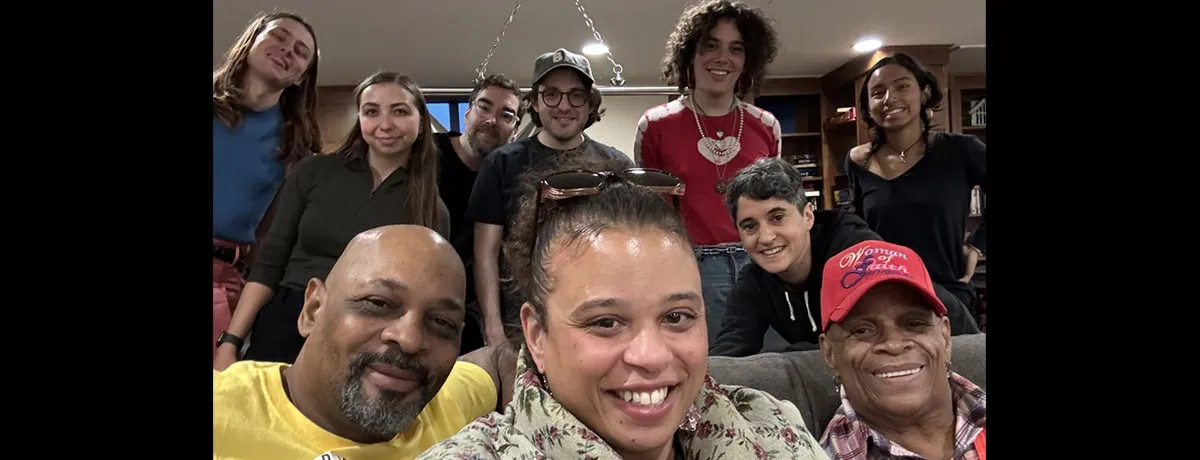
Award-winning artist, filmmaker, writer, and activist Tourmaline has spent over two decades lovingly researching and preserving Marsha P. Johnson’s life. In two books published this past spring—MARSHA: The Joy and Defiance of Marsha P. Johnson, the first comprehensive biography of Johnson, and a children’s book, One Day in June—Tourmaline provides a richly textured story of Johnson’s life that humanizes one of the most iconic figures of the 1969 Stonewall rebellion and Street Transvestite Action Revolutionaries (STAR).
Tourmaline is also a veteran BCRW collaborator. With BCRW’s Creative Director Hope Dector as producer, she has created film projects including Salacia (2019) and a forthcoming film about Johnson’s early life. A former Activist-in-Residence at BCRW (2014-2018), Tourmaline’s collaborations with Dector have also produced award-winning video series on abolition, “No One Is Disposable” and “I Use My Love to Guide Me.” In 2016 Tourmaline was the first trans woman to give the keynote lecture at BCRW’s annual Scholar and Feminist conference, “Sustainabilities,” and in November 2025 she will give BCRW’s McIntyre Lecture. An excerpt from Tourmaline and Dector’s in-progress film, which draws on new footage from Johnson’s early life and interviews with those who knew and loved her, will preview at that event.
On a Tuesday morning during Pride month in New York City, amidst a rigorous press tour for MARSHA, Ana Sofia Harrison (BC ’25)—former BCRW Research Assistant and PA for Tourmaline’s film—sat down with Tourmaline and Dector for a conversation about their decade-plus creative collaboration and finding inspiration for trans resistance in Johnson’s life.
Ana Sofia: Thank you so much for meeting today, it means so much to me to take this time together, especially during Pride month. I look up to both of you and the work you do to highlight queer and trans experiences. Why is telling Marsha P. Johnson’s story important, particularly the lesser-known parts of her life? Why is this story important right now?
Tourmaline: I’ve been blessed to be able to know about, learn about, and educate my community about the life of Marsha P. Johnson for nearly twenty years now. It’s been a remarkable, just abundant, inspiring, and enlivening aspect of my life for nearly two decades.
I’ve learned that while during Pride, we might see a beautiful mural of Marsha, or we might, you know, hear a few lines of what Marsha said, or know a particular moment in her life, she was a full person. She lived quite an expansive life, and all aspects of that life really contributed to this iconic, unique, powerful, fabulous person. That life that still offers a blueprint for how to move through harsh conditions—the same ones that we’re facing right now. When we look at Marsha’s life, we learn about how she cultivated a relationship with God, how that inspired her performance art, and how that inspired a desire to move from New Jersey to Times Square, where she met her sisters, who were trans and gender non-conforming people, in the early sixties.
They gathered and rented hourly hotels that they called “hot spring hotels” because, whether it was winter, spring, summer, or fall, they were boiling. It was really an intense place to spend time. But at the same moment, it provided a little bit of relief from the harsh conditions, the violences they faced on the street. They used that time inside these hot spring hotels to dream. In beautiful interviews with Steve Watson both Sylvia Rivera and Marsha P. Johnson talk about how important it was to just be there and ask questions like, “what might it be like to move through the world without facing such violence?” and “how can we know our beauty in an even deeper way?”
And so, for me, studying, learning, and educating my community about that moment provides a blueprint, a plan, and a sense of knowing that while we navigate similarly harsh conditions right now, when violence against our communities is continuing to rise, we had a leader who came before who dreamed beyond those harsh conditions and moved with inspired action to transform them.
I also think it’s important to know that that flashpoint at Stonewall didn’t come out of nowhere. It came out of deep consideration, and it came out of freedom dreaming. The organizing that happened after Stonewall with Street Transvestite Action Revolutionaries (STAR) came out of a moment of deep freedom dreaming. The more we know about Marsha, the more informed we can be about how to navigate similar rough waters.
Ana Sofia: What was the most challenging part about working on Marsha’s story?
Tourmaline: Honestly, it has just been nothing but a blessing. Part of the reason why I wrote both MARSHA: The Joy and Defiance of Marsha P. Johnson and One Day in June is because I wanted to be able to share the gift of getting to know Marsha P. Johnson and her loved ones with younger readers.
Hope and I were at Marsha’s family’s apartment in Elizabeth, New Jersey, right before the book came out, and we were sitting around the kitchen table with Jeanie Michaels, Marsha’s sister, Bob Michaels, Marsha’s brother, and Al Michaels, Marsha’s nephew. We talked about how incredible it’s been that Marsha’s life has become so expansive and abundant even while she’s not in her physical body, and that her life just continues to grow and grow and grow. And so, to me, it’s been a remarkable thing, getting to know the people that were close to her.
As for the challenges, sometimes it means having a conversation often with someone who knows what they want to express, and other people are grumpier about being interviewed. Yet then, by the end of it, by just spending some time talking about Marsha, they inevitably leave the interview feeling more joy, more of a sense knowing that they were in touch with an important person and feeling that they themselves are important people. Marsha had an incredible capacity to reflect people’s value, and when people are remembering those stories of Marsha or remembering their friendships with Marsha, they’re also spending time remembering their value.
Ana Sofia: What was the most unexpected, surprising, or like just fun piece of this project?
Tourmaline: Yeah, I mean, it was all fun. I loved learning how Marsha was really like an L.A. girly. We always think of Marsha in terms of her life in New York, and rightly so, and, more so these days, in Elizabeth, New Jersey. I love learning about the drag bar histories in Elizabeth and throughout New Jersey, and that’s why I included a lot of it in the first chapter. However, some of my favorite portraits of Marsha are these Polaroid photos where she’s in a silky blue dress and she’s adorned with a leather coat and she’s standing in front of a rose bush by a pool and Calabasas, right outside Los Angeles.
I drove to that house in Calabasas a few years ago, and it’s still there. There’s a huge olive tree in front of it, a pool in the backyard, and glass wind chimes. It just felt incredible to be hot on the heels of Marsha’s physical life, but then also to remember that the most powerful part of Marsha’s life is unfolding now. It’s in the conversations that we’re having right now and in the ways that we’re dreaming and moving in Marsha’s legacy.
Ana Sofia: Hope, I would also like to offer you the same question. Why do you think telling Marsha’s story is important, particularly these parts of her life that you and Tourmaline were able to explore together?
Hope: Something that I think about a lot right now is the importance of connection. Tourmaline has taught me about connection, and about the dangers of isolation. Studying Marsha’s life, learning about Marsha’s life, getting to know her family, all of that, those are all forms of connection. All these different projects Tourmaline has done—books, films, archival histories of Marsha’s life—are all about creating a historical connection and a personal connection to Marsha and to feeling Marsha’s presence. Understanding Marsha more deeply as a person helps us to understand ourselves more deeply as people, understand the connections that we have to each other, and understand the history that we’re living through today.
Ana Sofia: So now I’m going to shift a little bit to asking about your collaboration and partnership in this work. How has that emerged over the years?
Tourmaline: Hope, why don’t you take that one?
Hope: Well, let’s see. I would say I have been very lucky to have Tourmaline in my life as a collaborator. I first met her over a decade ago through my work at BCRW. Tourmaline spoke at BCRW, at a couple different conferences, but in particular, I remember that she led a workshop on prison abolition at The Scholar and Feminist conference on Utopia in 2013. I think that was the first time that we actually met. Then through the conversations we had there, I got to know Tourmaline a little bit better and we started doing a few video projects together. In the early days those videos were conversations mainly related to prison abolition in collaboration with people like Dean Spade and CeCe McDonald.
Tourmaline was invited to be an Activist-in-Residence at BCRW 2013, just at the time that she was pivoting from the work that she was doing at Sylvia Rivera Law Project to some artwork that she was creating as a practicing artist and a filmmaker. That’s when our collaboration turned towards the filmmaking projects. Those projects have included an animation project on Miss Major and also a number of films that have spanned genres.
Ana Sofia: Amazing. Tourmaline, do you have anything yet to add to that?
Tourmaline: Just that I’ve been similarly blessed to collaborate with Hope Dector. It’s been an ongoing, unfolding journey that has taken us to Venice, Italy, and Elizabeth, New Jersey and, you know, our works are in the MoMA and at the Tate. And it’s all done in an office at BCRW! We filmed the work that’s at MoMA and Tate downstairs at Barnard in IMATS [Instructional Media and Technology Services].
Ana Sofia: Wow, I had no idea!
Tourmaline: Yeah, it’s really a Barnard project.
Ana Sofia: So cool. Awesome. This next question is also for both of you. How would you describe your artistic practices and how have they evolved to where they are now?
Tourmaline: Hope, why don’t you go first?
Hope: I’ll talk about this in terms of my role as a producer for Tourmaline’s work. I think I have come to understand the work of producing as about the connection with Tourmaline as an artist and about her vision. It’s about trying to understand her vision, trying to make what she wants to exist possible in a very logistical sense, in terms of being able to produce the shoots that enable her to create the visual work that she wants to create.
It’s also about sharing vision. It’s about really developing something together that is maybe never going to be the exact thing that the original idea was—it’s always going to develop and shift, and that’s such a beautiful process, one that I feel so lucky to be part of.
Ana Sofia: And what about for you, Tourmaline?
Tourmaline: Yeah, I think the collaboration has just similarly evolved. Earlier it was about the importance of these stories and the necessity and the urgency. Now it’s in a, like, “nothing serious is going on here” octave of seeking the fun in it and the pleasure and letting everyone else arrive at their understanding of the importance.
Hope: I also think that from our earliest films that were educational videos to these more artistic collaborations, there’s just such beauty in Tourmaline’s films. This gets at what she was saying about the idea that “nothing serious is going on here,” and just feeling the pleasure and enjoyment. The films that she makes are just so beautiful to watch on multiple levels that there’s a real pleasure in them and a real enjoyment for their existence in the world.
Ana Sofia: I just love hearing about your collaboration because I feel like it’s something that I haven’t asked Hope much about, even when working with you as a Research Assistant at BCRW. Hope, you’re very behind the scenes, so I just feel like I don’t hear so much about the process of your collaboration.
Hope: I like being behind the scenes, it’s true.
Ana Sofia: Tourmaine, I was listening to your interview with Matt Rogers and Bowen Yang on the Las Culturistas Podcast and I was thrilled to hear a lot about how theme parks influence you. I wanted to ask you and Hope about how this topic of theme parks—I know you’ve been to Disney together—relates to your artistic vision and practice.
Tourmaline: I’ve found that I have my greatest access to clarity, timing, and energy to transmute a problem into a solution when I am in a place of pleasure and joy. I’ve realized that beauty, pleasure, and joy aren’t throwaway, superficial things.
So, why Disney? There’s just something to me about asking, how do I as an artist create an emotionally impactful experience through scent, physical landscape, immersive environment, or a paradigm-shifting, physical movement of the body? It reminds me of the very first experiences of cinema that I had of watching Dorothy in The Wizard of Oz move from black and white to technicolor. It felt like someone picked up my brain, rotated it at forty-five degrees, and put it back in my body. And I was just like, what is this? As an artist, I like to have that kind of movement throughout a lot of my work. It’s why in Salacia Sylvia Rivera cuts in from 1995 in a 1800s period piece, or why there’s an interchange in Happy Birthday, Marsha! between Mya Taylor playing Marsha and Marsha P. Johnson as narrator. In a place like Disney, for me, I experience a kind of paradigm shift. I experience a movement, like an emotional upward spiral. I experience a level of joy and euphoria, which I think especially in this moment, is so important.
The transformation doesn’t have to come from an amusement park. I remember the first time that I went to Fort Greene Park in the summer of 2005 at Soul Summit, where I had this powerful experience at AfroHouse’s outdoor dance party. There was a sense of euphoria and joy that I was moving through in a physical sense, in a public space, in the middle of the day. There’s something about it happening at high noon, you know, publicly—we were publicly enjoying ourselves. And for me, with theme parks or Disney, I’m a student and an artist who is studying and asking, how do you create a kind of experience that leaves you with a shift in perspective and a reorientation?
Ana Sofia: Yeah, I really like what you said also about it being high noon and taking up the space and enjoying it.
Tourmaline: Hope, what do you think?
Hope: I think what we can learn to ask from going to an amusement park is, what does it feel like to just do something purely for enjoyment, purely for fun? And how can we bring that into our lives in a more day-to-day way? That’s part of why we’re here, right? That’s something that shouldn’t be undervalued, especially right now when we need those moments to feel lifted.
Ana Sofia: Yeah, that feels like an active resistance and protest. That just brings me to one more last question that I feel can really speak to this moment. You both identify as artists and activists. How do those two intersect for you?
Hope: For me they are parts of the same project and parts of the same life. I think that’s part of what this whole project on Marsha is about. She was never just this trailblazing activist who led the way for trans and queer liberation. She was always also an artist and a kid from Elizabeth, New Jersey who was singing in the choir at her church and who was going to the grocery store with her mom. We’re all connecting the different parts of ourselves through everything that we do, whether we’re going to Disney, or making a film, or protesting, or organizing a campaign. We’re all just whole people, and that’s much more interesting than just being one thing.
Ana Sofia: Yeah. And how about you, Tourmaline? What do you think about the two and how they merge?
Tourmaline: Yeah, I don’t know if I can add anything to the fullness of Hope’s answer.
Ana Sofia: Yeah, that was an awesome answer.
Hope: Oh, thank you. Well, thank you so much, Ana Sofia, and thank you Tourmaline for being part of this interview.
Tourmaline: Yeah, this is great. Are there any more questions?
Ana Sofia: I mean, I’d pick both of your brains all day if I could. For this project, I feel so full and I’m really glad that we could do this. I feel like Marsha was here.
Tourmaline: Yeah, definitely.
Ana Sofia: Thank you both so much for your time. It was an honor to talk to you.
A Guggenheim Fellow and TIME100 Honoree, Tourmaline is an artist, filmmaker, and national bestselling author whose work spans high art and pop culture. Tourmaline’s art is in the permanent collections of The Met, MoMA, Tate, and the Whitney, among other museums. Her influence in contemporary art has also been showcased in both the Venice Biennale and the Whitney Biennial. Tourmaline’s award-winning films—including the critically acclaimed Happy Birthday, Marsha!; Salacia; Atlantic is a Sea of Bones; and Mary of Ill Fame have been widely recognized for their unique blend of historical narrative and speculative futurism. Tourmaline’s commercial film projects have premiered at the MTV Video Music Awards, and she has led the creative for brand campaigns with Fortune 500 companies, such as a film series presented by Unilever on the topic of LGBTQ+ communities in rural America.
Tourmaline’s new book MARSHA (May 2025) is the first definitive biography of the revolutionary Black trans activist Marsha P. Johnson. It was named a National Bestseller, received a Starred Review by Publishers Weekly, and was selected by The New York Times for inclusion in the Nonfiction Spring Book Preview. Her children’s book ONE DAY IN JUNE (May 2025), also inspired by Marsha P. Johnson’s life and activism, received a Starred Review by Publishers Weekly.
The recipient of the BlackStar Luminary Award, Stonewall Visionary Award, HBO Queer Art Prize, and the Baloise Art Prize at Art Basel, Tourmaline crafts worlds across a variety of media that center pleasure, possibility, and transformation. She is a sought-after speaker at institutions like Princeton, Yale, MoMA, The Met, UC Berkeley, Smith College, and Outfest, and has been frequently featured in The New York Times, Vogue, Artforum, and TIME Magazine. A former leader of the Trans Health Campaign at the Sylvia Rivera Law Project, Tourmaline has built a career rooted in community organizing and trans liberation, and is a transformative voice in movements for racial, economic, and gender justice.
Tourmaline is a graduate of Columbia University and lives in Miami with her partner Cameron and their cat Jean.
Hope Dector is an artist, filmmaker, multimedia storyteller and the Creative Director at the Barnard Center for Research on Women (BCRW). At BCRW they collaborate with artists, activists, and scholars on multimedia projects, including the production of original video content. Dector has spearheaded the development of BCRW’s digital presence, including its YouTube channel, online programming, and S&F Online, the first peer-reviewed, open-access journal in the field. They have worked with several visionary artists and activists, including Tourmaline, Dean Spade, and Mariame Kaba through films and projects with themes of abolition, queer and trans liberation, mutual aid, and transformative justice. These works have screened at institutions around the world, including the Venice Biennale, Brooklyn Museum, Tate Modern, and MoMA.
Ana Sofia Harrison is a recent graduate of Barnard College who grew up in New York City. She majored in Human Rights and Women’s, Gender, and Sexuality Studies and minored in Art History. During her time at Barnard, she was a Research Assistant at BCRW and was a PA on the set of Tourmaline’s forthcoming Marsha P. Johnson documentary. This past year, she interned at two non-profits, including Surveillance Technology Oversight Project (STOP) in New York City and Correlation European Harm Reduction Network in Amsterdam. Her honors thesis project focused on systems of harm reduction practices, comparing public health harm reduction approaches to grassroots, liberatory harm reduction. In addition to Harm Reduction, reproductive justice and prison abolition are her two main interests, as well as telling activist histories through visual art.