
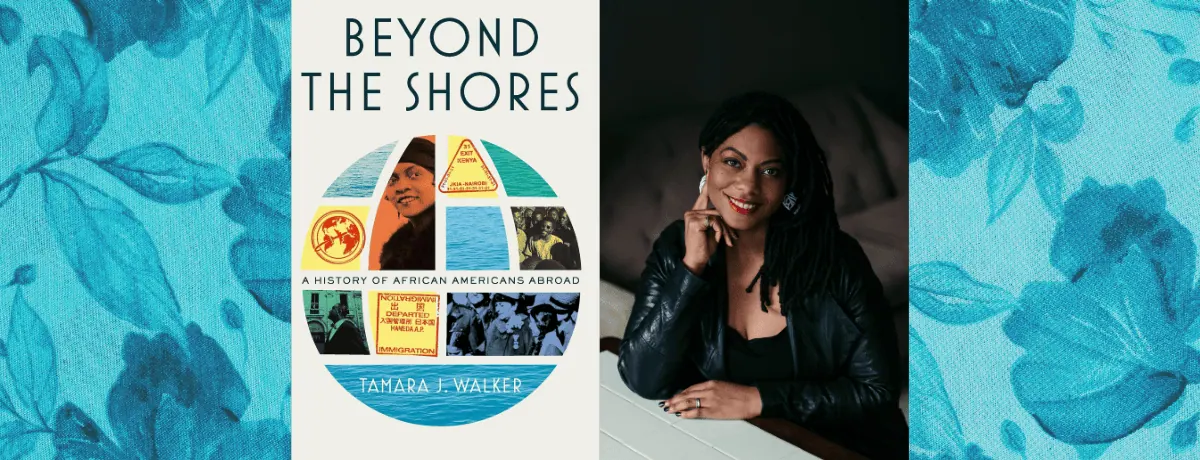
Barnard Professor of Africana Studies Tamara J. Walker is an experienced storyteller of elsewheres. As a historian she tells stories of the past; as a Latin Americanist she writes from outside the global north (her first book Exquisite Slaves (Cambridge University Press, 2017) examines the clothing of the enslaved in colonial Lima). As a lifelong traveler she founded her nonprofit, The Wandering Scholar, to make international travel accessible to high schoolers from underrepresented backgrounds. Walker’s most recent book, Beyond the Shores: A History of African Americans Abroad (Penguin Random House, 2023), combines these prior strands of her work while taking them in new directions. As an exploration of Black American global travel in the 20th century, each chapter of the book takes readers on a chronological journey from the 1920s to the 1980s by telling the story of one Black American in a foreign locale. Between these histories Walker writes autobiographically of her and her family’s experiences as Black Americans abroad. Kelsey Kitzke (BC ’23) sat down with Walker for a conversation about this expansive and personal tale of how racemaking transforms across time and borders, what it means for Black Americans to search for humanity elsewhere, and the complex beauty of making your way in a new place.
Kelsey Kitzke: I wanted to start with how you arrived at the project and how it fits into your previous scholarship. I know that you’ve done a lot of work in colonial Latin America. Did you see this project as within that work, or was it a departure?
Tamara Walker: I always say that I never would have become a historian of Latin America had I not had the experience of travel at an early age. I never would have been able to write Exquisite Slaves had I not had the experiences that I wrote about in Beyond the Shores. And then I don’t think I would have written Beyond the Shores the way I did, had I not had the experience of writing another book, being a Latin Americanist, and thinking about race the way I do. And I think that came through in this book: thinking about race in different regional contexts and how it fundamentally changes someone’s experience of a place shows that the US racial model is not the only racial model that operates in peoples’ day-to-day lives or people’s traveling lives. And so even though it represents a departure in terms of context from the work that I’ve done before, it’s very much connected to my overall intellectual trajectory.
KK: Before we get into more of the content of the book, I wanted to ask about form: the book is at once a travel memoir, traditionally very escapist, but it is also a grounded social history. Were you thinking about those tensions when you were deciding how to write it? It’s a very cross-genre book and it’s so wonderful to read because of that.
TW: That’s such a great way of framing it. I think that I hadn’t come up with the framework for the book until I started writing it and realizing that there was a tension between wanting to communicate my own travel experiences (and connect that to my family’s experiences) and wanting to write a more straightforward social history. I was always aware that I was but one person who was a part of this larger familial history, this larger cultural history, and this even larger history about this phenomenon of African Americans moving around the world in search of opportunity and humanity. What I ended up arriving at was this kind of hodge-podge book that I think really helps to contextualize the narrative chapters that are about individual people that embolize what was at stake for African Americans during particular decades of the 20th century. It unfolds chronically and it speaks to both different moments in US history and different dynamics in parts of the world that African Americans were either drawn to or being invited to.
I was a Fulbright Scholar, which was founded during the same time period as the Peace Corps, so I saw a connection between myself and Herman DeBose. I wrote about the piano player Phillipa Schuyler, who traveled as a teenager at the same age that I traveled to Mexico. There were ways of using my own experience to help contextualize the people I was writing about and explain my decisions in writing about them. There were other people that I wrote about because they were windows into worlds that I wish I had a better understanding of. I’m thinking about Mabel Grammar, who is a woman who accompanied her husband, Oscar Grammar, to Germany following World War II as part of the rebuilding efforts. My grandmother accompanied my grandfather to Austria during that same time period. In using the tools of the historian, and looking to this other person, I was able to get some sense of what that may have been like for my grandmother. That’s the beauty of history: it allows us a way of understanding ourselves in ways that we don’t always anticipate.
KK: You mention in the prologue the challenge of only being able to pick a handful of the many stories you collected to tell in the book. Out of all of those stories, were there specific themes of the Black experience abroad that you were thinking about before you chose the stories you put in the book? And how did those stories bring those threads out?
TW: Absolutely. One thing I was thinking about was just how large Paris looms in the history and cultural imagination of Black Americans abroad. So I knew I needed to reckon with and address that, but I wanted to do it in a way that at least for me was new. That wasn’t about centering Josephine Baker, Richard Wright, and James Baldwin. That was about recognizing them and acknowledging their importance and prominence while also making room for other people that we know less about. I ended up choosing Florence Mills because she spoke to the larger phenomenon of African Americans going to Paris. In that chapter I also talk about London because Paris wasn’t the only place in Europe that Black Americans went in the 1920s. They weren’t just in Paris, they were in London, they were in Berlin, they were in Salzberg and Vienna. In talking about Florence Mills, I was moving away from those key figures, and in talking about Paris and London, I was moving away from that key site and drawing some comparisons that showed that Europe wasn’t all the same, that there wasn’t a universal Black experience in Europe. That was one theme I knew I wanted to grapple with going in.
I also knew I wanted to have more regional variation. I wanted to look at South America, and in that I was able to talk about Richard Wright, who we think of as in Paris, but I put him in Argentina where he lived while he was filming a movie. I was able to go to Asia through Kim Bass’s experience. And then I wanted to just acknowledge that different people experience even the same places differently, and so I wanted to attend to gender differences, to age differences, and to skin tone differences to show that there’s no singular experience. And it’s not singularly romantic either—there is so much romance in travel, I mean I don’t make a living writing and researching and thinking about travel for no reason—but I also wanted to complicate it. I wanted to talk about the tragedy that African Americans had to leave the US to have an experience of humanity and self-discovery. Not to emphasize tragedy and make that the centerpiece of Black life, but to recognize that even when it comes to travel, we have to attend to these complexities and not be blind to them for the sake of telling a story that is fun and pleasurable.
KK: Speaking of attending to gender differences, I want to ask about the Philippa Schuyler chapter, where gender comes into play intersectionally, to her advantage and disadvantage. While in Mexico, Schuyler is able to participate in the kind of girlhood that she was denied in America. But then there’s that striking scene later in her life where she’s kidnapped in Venezuela because American soldiers mistake her as Venezuelan, and assume she is a sex worker or an object of sexual violence. How were you thinking about how gender played into the story for Black women in particular?
TW: That was something I had been thinking about my whole traveling life: that my experiences as a Black woman were necessarily different from anyone else’s, and I knew this from all the conversations I was having with friends who were from different backgrounds. I chose Philippa partly because I wanted to talk about that. One, to your point about girlhood, it’s only really when she travels that she’s able to just be a girl. She went to Mexico to perform, but she did other things too. She made a friend along the way on the train ride down from Texas. She wrote an article about her experience with these young girls that she meets in Mexico and the things they talk about. They talk about dancing and clothes, and they also talk about big things: politics, like the Good Neighbor policy. I wanted to capture that too because that feels specific but also kind of universal, that you make friends when you travel and you compare notes about what it’s like to be a young woman in one country compared to the other.
There was the other part that you point out: that she was vulnerable as not only a young woman but also as someone who had a spirit of adventure and was often traveling by herself. She was mistaken for a Venezuelan woman and was able to talk her way out of it, speaking English to these American men. But the Venezuelan women who they presumed her to be would not have been so lucky because they assumed that because she was Venezuelan she was sexually available. This story also tells us about what it must have been like for the Venezuelan women themselves: What did it mean for the women who couldn’t point to being American as a reason that they’re no longer sexually available in that way, that the rules don’t apply?
KK: I was interested in the times that Black Americans were participating in the American colonial project—especially in the story about the Peace Corps—and other times they witnessed other countries’ colonial projects, as they met Black immigrants from Africa and the Caribbean who were coming to European countries that had colonized their homelands. What of that colonial tension?
TW: They were all products of their particular historical moments. And that’s why I went decade by decade to really ground us in the historical context of the US and different parts of the world. I was trying to be mindful of historical context, of regional context, and recognize that African Americans were mindful of it as well. They were tremendously discerning readers of the Black press, and astute travelers who compared their experiences in different places and were really reflective about their privileges as Americans.
Some of them didn’t necessarily problematize it, and in fact they really appreciated the experience of being American and reaping the privileges of being American when they traveled. Others were aware that it put them at an advantage that others didn’t have and they were sitting in the discomfort of that. Just to go back to the Soviet Union examples, there were so many Black Americans, including the agronomists I talk about in that chapter, who were made uncomfortable by being called comrades and by the Soviets standing up and giving up their seats on the bus. It struck them as performative, and that’s because it was. The Soviets were aware of the segregation of public transportation in the US and the fact that Black Americans had to sit at the back of the bus, and they were engaging in a propaganda effort and Black people understood that. At the same time, Black people were like, well it’s nice to be able to sit down on the bus and be treated as a comrade and a brother rather than be treated as a problem and an alien. That’s the complexity of their experience too. Even as they were being critical and aware of what was happening, there was also something that was refreshing and a break from the struggle that they had endured back home.
KK: And it sounds like Black Americans are experiencing solidarities, if you’d like to call them that, throughout the world that is often—to go back to travel memoirs and that kind of genre—less available in white travel stories. There often isn’t that connection to various levels of society or a reckoning with the fact that there are complex hierarchies going on.
TW: That’s a great point. Something that comes through in a lot of women’s travel memoirs is that they perceive freedoms that women have in various parts of the world that they don’t have, or they recognize the freedom they have as travelers that women in more conservative societies don’t have. So some of that I think is gendered. But certainly, to your point, there is a sense of solidarity that emerges in a lot of the stories that I write about. And sometimes that’s out of necessity too, where people find themselves in places where they’re quite lonely and they’re one of the only African Americans in a given community, so the way they go about building community and friendship is about recognizing points of commonality and reaching across differences.
What you’re also making me think about is this specter that emerges throughout the book that I didn’t quite clock until I saw it a couple times, which is the specter of white Americans abroad. In Moscow, in Paris, and other places, Black Americans couldn’t entirely leave racism behind because the white Americans that were also traveling in those places under different circumstances wanted to preserve racial hierarchy and wanted to have Jim Crow travel with them. So, speaking of puncturing the sense of romance when it comes to travel, that was a real moment where I was like, okay they’re in a different world, but they’re also not.
KK: Were you thinking about the Green Book when writing this?
TW: When I originally sold the book, “The Global Green Book” was its title. I called it that when I was pitching it because my reading of the Green Book always had a global element. When people think about the Green Book they think about the resources that it provided as far as where to eat and sleep and rest your head as you were making your way, for example, from New York down south or from down south to California. But there were always sections about Mexico and always sections about Canada and then, increasingly in the 1940s and 1950s, there were sections about Europe. They weren’t as instrumental as they were in the US, like here’s a hotel to stay in, here’s a restaurant that will take your money. Instead, it was like here’s shopping to do and here are sites to see. And so, when I named the proposal, I was trying to capture the sense that African Americans had always had this global experience of travel that was more focused on experiences of leisure and pleasure.
My title is also connected to the Great Migration and Isabel Wilkerson’s book The Warmth of Other Suns, whose title comes from Richard Wright’s autobiography where he talks about leaving the Mississippi of his birth for Chicago with his family to experience “the warmth of other suns and perhaps to bloom.” The title of my book, Beyond the Shores, comes from Wright’s experience of moving to Paris and needing to move “beyond the shores of his native land in order to experience humanity.” And that’s to say that it wasn’t enough to go to Chicago, because the sun didn’t shine bright enough in Chicago. He had to go even further; he had to go beyond the shores of the US. I saw my book as being in conversation with Wilkerson’s, and what better embodied that connection than this person, Richard Wright, who is visible in both of our books.
KK: Before we wrap up, I want to ask one question that you touch on in your memoir section about being in Canada that this past election reminded me of, this kind of swell of middle- to upper-class white liberals talking about leaving the US in a way that is often quite hollow. You describe it as a second white flight or that kind of instinct to leave when the going gets tough. I don’t have a specific question, but I’m wondering how you’re thinking about that? I find it kind of baffling, this idea that America is not a part of global processes.
TW: Yeah, I have so many thoughts about that from all the vantage points that you signal. Even now as there’s this kind of return to that possibility, ‘I’m going to move to Canada. Or I’m going to leave the US and go to Europe.’ So many people are saying that there’s this “Blaxit” phenomenon that emerged with the first Trump election and has revived itself with this one. When I was writing this book, I felt a real connection to something Paul Robeson had said when he sat for an interview on Australian television where they were basically asking him, you know, we’re in this moment where Africa’s decolonizing and there’s all this rich potential in that part of the world, are you not tempted to go and make your home there? And he’s like, this is my home, America is my home, this place that my grandparents built and worked to contribute to, and there’s a lot of that place that belongs to me still. And it was really poignant to read that as I was finishing the book and to think about that now without being romantic or uncritically patriotic. That’s not at all what it is because the whole book is about the critiques people have of their country and how their critiques keep them away. But even with those critiques they come back. I absolutely understood the Blaxit phenomenon and the reasons for it and the joyful outcomes that people experience and the true sense of belonging. Everyone is entitled to that, deserving of that, but I also think it’s a complex set of choices and relationships.
KK: That complex belonging—how have you taken that into your life? Because this book is so personal. Post-writing the book, do you feel a new sense of belonging at home in the US or when you travel?
TW: I go back and forth. I always long for places I am not currently in. I clearly was longing for home when I was writing this book in Canada and now I long for that time [laughs]. So I think that’s just the nature of being someone who loves traveling and who does love to imagine themselves and different versions of themselves in different parts of the world. And the part of me that’s a historian is taken with different time periods and travels through time to do my work. But yes, I think the fun part of being a writer or a historian is that you get to transport yourself and transform yourself in different ways, even if it’s just for a short time.