
Lucyle Hook Professor of English and Africana Studies Kim F. Hall’s new book, The Sweet Taste of Empire: Sugar, Mastery and Pleasure in the Anglo Caribbean (The University of Pennsylvania Press, August 2025), centers the complicated history of sugar in order to ask what lies beyond its narrative of pleasure. Hall explores how the unique emphasis the English placed on confections as a marker of status and national identity in the seventeenth century offers a framework for grappling with changing notions of race, gender, labor, and domesticity that shaped early colonization. Drawing from a wide range of early Anglo-Caribbean texts—from cookbooks and banquet menus to economic poetry, to maps and treatises on plantation labor and health—Hall uncovers colonial discourses deployed across representations of Caribbean colonization and slavery. Working across the fields of Early Modern, Critical Race, and Food Studies, Hall offers us the language of plantation aesthetics in order to expose the violence ingrained in sugar that is made to disappear through the pleasure derived from whiteness, purity, and perfection.
Professor Hall sat down with former student Tomisin Fasosin (BC ‘25) to discuss how her book emerged from over a decade of research and her own complex personal history with sugar. In a wide-ranging conversation, they explore how sugar and the racialized labor that produced it shaped global modernity, literary and artistic cultures, and the lived experiences of Black women from the seventeenth century to the present.
Tomisin: I’m here with Professor Kim F. Hall to talk about your book The Sweet Taste of Empire. I really enjoyed reading it, especially the introduction. From the start, your vulnerability, humor, and personal relationship to sugar come through. How did you navigate that balance between the personal and the scholarly?
Kim: That’s such a great question. Writing this book was both a scholarly journey—trying to answer questions that had been on my mind—and a personal journey of learning to become a writer. Even though this is my third book, I never really thought of myself as a writer before. I saw myself as an academic who had to publish—you need to get your ideas out, you need to build your career.
That mindset actually slowed me down. The book took a long time because I was undergoing a kind of transformation. I took Michele Boyce’s writing retreat and learned so much about process. That helped me see writing differently, not just as a professional obligation but as something more creative.
At the same time, the field I work in—premodern critical race studies—encourages scholars to connect their personal experiences to their research. That wasn’t natural for me at first. I was trying to establish myself, earn tenure, and push back against resistance in the field. But it also limited how much of myself I felt I could put into the work. Now things are different: there’s an identifiable field, and I’m part of a supportive scholarly community. I’ve learned from colleagues and friends, and I felt freer to let more of myself into this book. Invitations to conferences also encouraged me. People asked me to put my anger, my perspective, my personality into my work, which was the push I needed to embrace it.
Tomisin: That’s so interesting—that people explicitly asked you to be yourself in scholarly spaces.
Kim: Yes. If you talk to me one-on-one at conferences, you’d know I have strong feelings about a lot of things. I think colleagues were nudging me to bring that more openly into my work.
Eric DeBarros’s review of my first book said that while it was a Black feminist project, it still leaned on a kind of apparatus of whiteness. And my co-writer Peter Erickson, who reviewed that book, pushed me to write more directly about other scholars’ work. I didn’t go as far as he wanted, but those nudges were important.
At the same time, I was getting invitations to speak at conferences where organizers said, “We want you to put your anger out there—your voice.” That gave me permission to embrace it.
Teaching also played a big role. When I taught the Worlds of Ntozake Shange class, I asked students to be brave in their writing, to experiment in ways that matched Shange’s fearless, inventive language. To model that, I wrote weekly blog posts alongside them. Through that process, I learned to write with both precision and personal honesty. I realized I could be rigorous in my analysis while also grounding the work in who I am as I move through the world.
Tomisin: I love what you’re saying about language. In your book, you connect your writing life to a conflict between luxury and abstinence, excess and restraint—concepts that shape how we talk about food in the West. I found that so striking, especially since you link it to sugar, which so many of us are obsessed with. Can you speak more about that?
Kim: Part of it is very basic. In one professional development program I did, they encouraged faculty to write for thirty minutes at a time and then reward themselves with a treat. It didn’t have to be sugar, but often it was. For me, some of the pleasures of writing are tied to those small rituals—working with friends at a café, sharing a mocha, or sneaking M&Ms with my friend Gwynne while we polished conference papers.
Over time, I learned that willpower isn’t endless. Psychologists say if you use a lot of it in one area—say, dieting—you have less for other challenges. I’ve always felt caught between wanting to model restraint and indulge in pleasure. That tension is rooted in a Puritan ideal of separating mind from body, of discipline over desire. So sugar became a way to think about writing itself. There are parallels: we talk about “binge writing,” and I was a binge writer who was consuming chocolate while I consumed time at my desk. The language overlaps in fascinating ways.
And if you look at songs about sugar, they’re so often about desire and pleasure, sometimes even as a euphemism for sex. Gloria Naylor, in The Women of Brewster Place, has this great metaphor of a character chewing sugarcane until all the sweetness is gone, leaving only woody bitterness. That captures sugar’s allure perfectly: it draws you in, then forces you to decide when to stop. Writing can feel like that too.
Tomisin: I was really struck by your use of the term “sugar worke.” That was the first time I’d encountered it. How did you come to that term, and how are you reworking it in this project?
Kim: It actually started very simply. In my classes, I encourage students to pay close attention to early modern texts, even when the spelling or typography feels strange. As I was reading, I kept noticing the phrase “sugar worke.”
In cookbooks and household manuals, it referred to elaborate confections—marzipan sculptures, molded sugar pieces—that elite white women created. But plantations and factories were also called “sugar works.” Suddenly, I realized that the same phrase linked the artistry of wealthy women in Europe with the brutal labor of Black women and enslaved people in the Caribbean.
For a long time, scholars had discouraged me from putting those worlds together. But I felt the term itself collapsed that false separation. So I decided to claim it—with the final “e”—as a way to hold both realities in the same frame. Of course, it was a nightmare for copy editors. But I hope the term gives readers an immediate sense of the connection, one that resists the tendency to split elite artistry from enslaved labor.
Tomisin: For me, “sugar worke” grounded your point in the importance of focusing more on the labor behind a lot of the goods and services that we have in the West. I feel like that was a very perfect term. I also love how it’s almost like feminized in a way with the work with the e at the end. One of the major interventions that you make in this book is, to quote from the preface, where you mention that Caribbean plantation slavery is an origin site for modernity. Can you talk more about how that question or that statement frames the questions that you brought to this project and how you see your work intervening in the fields of critical race studies and literature?
Kim: I’m not the first to make that intervention. For a long time, scholars treated race and modernity as things that “really” start in the eighteenth century, or even later. But if you look closely at the sixteenth and seventeenth centuries, you see how race is already being constructed and how deeply entangled that is with the rise of capitalism. Sugar wasn’t just a commodity; it was a driver of global trade, shaping tastes, economies, and bodies. And it was built on the labor of enslaved Africans in the Caribbean. You can’t separate the emergence of the modern world from that system.
So part of what I’m pushing for is a temporal shift. We need to stop thinking of race as something that “comes later” and recognize how early it structures economic, cultural, and intellectual life. This isn’t to say nothing new happens in the eighteenth century. Of course it does. But if we only look there, we miss the ways race and capitalism are already co-creating each other much earlier. That shift also helps us see how gender is woven in. Elite women making sugar confections in Europe were part of the same system that depended on enslaved women cutting cane in the Caribbean. Those connections are foundational, not incidental.
Tomisin: I can definitely see you pushing the boundaries with this temporal shift, as well as with your incorporation of food studies with critical race studies, which are not usually part of the conversation.
Kim: Food studies was always central to this project, and being in Africana Studies at Barnard meant I could teach courses that linked food and literature. The field has become much stronger in recent years—more critical, intersectional, and justice-focused—but when I first started, it often relied on amateur histories or celebratory narratives, especially nationalist or liberal feminist accounts of food origins.
When I drafted my first proposal, the book was going to cover sugar, tea, chocolate, and coffee. I found fascinating origin stories—about tea ceremonies in England, for example—but once I dug into the archives, most of them collapsed. I realized I needed to do something more rigorous. A turning point was going with Professor Quandra Prettyman to a lecture by food historian Karen Hess, where Hess dismissed much of popular food studies as uncritical and romanticized. That made me want to write a book that was both politically urgent and as detailed as possible.
At the same time, I was working on early modern women writers and became interested in the cookbooks they wrote and read. But there was resistance to seeing these women as racialized subjects, which limited the conversation. I began to see sugar as the thread running through everything—both the confections of white European women and the labor of enslaved Black women in the Caribbean.
My earlier research on Black figures in early modern European art reinforced this connection. I kept finding paintings where Black people were depicted alongside luxury goods like sugar, tea, coffee, and chocolate. That persistent pairing made me ask: why was Blackness so strongly tied to these commodities, and why did elite families reproduce that image again and again? Those questions ultimately pushed me to reimagine the book as one focused entirely on sugar and how it shapes how we experience both pleasure and oppression.
Tomisin: This leads perfectly into the next question because I was going to ask about your archival process. You were mentioning a bit about how, at first, it was hard to find anything relating to sugar and specifically Black women. Can you speak to this absence in these archives and kind of how you navigated that throughout this book?
Kim: It’s so interesting. Thanks to the work of feminist historians and geographers—like Judith Carney’s Black Rice and Jennifer Morgan’s Laboring Women—I knew Black women were there. I assumed I’d find them directly in the archives. But when I read promotional materials, especially about Barbados in the seventeenth century, where we know Black women and children made up much of the population, they were barely mentioned.
So I wasn’t looking for Black women simply as numbers. I wanted traces of their experiences and labor. I’m not a historian, but as a literary scholar I could ask: what narrative strategies make Black women disappear, even though they were everywhere?
As I learned more about sugar production and daily life on plantations, I began to notice the silences. I expected references to Black women at certain points, but they never appeared. That made me ask why. What was driving their erasure? Some of it is familiar—Black feminists know this pattern of historical disappearance—but it’s still striking. How can you describe sugar production as if Black people weren’t everywhere in it?
In a graduate seminar I took with Elaine Scarry, we talked about how labor often disappears from the record. But I felt something more was happening here. Black women weren’t entirely absent; they surfaced in moments of anxiety, like fears about mixed-race reproduction or in texts about white men’s desire. My training in close reading helped me treat those gaps and glimpses as meaningful, rather than as accidental.
Tomisin: And as a literary scholar, you’ve said that English literature is deeply tied to English economic activities and desires. What does literature give you access to that other primary sources don’t, especially for this project?
Kim: Literature lets us see racial formation as it’s happening. Data—like numbers of plantations, taxes, or sugar bakers cropping up in Europe—is important. But in narrative descriptions, in people articulating their desires, you can actually see the making of new white subjects and the shaping of racial hierarchy.
That’s why the most powerful work in Black feminist history is so interdisciplinary. Literature gives us tools to read texts not as transparent accounts, but as performances, repetitions, disruptions, rituals, and incitements of desire. Stephanie Smallwood, for example, describes the slave market as a theater. That’s exactly how I think about food rituals in English culture: they’re staged performances that naturalize empire, race, and consumption.
As literary people, we’re trained to see what a text is trying to do—to incite desire, to normalize hierarchy.
Tomisin: Thank you. I feel like we’re so aligned in this interview. You mentioned Kara Walker, and I love her work too. I first encountered A Subtlety in a curatorial class where we put together an exhibition on Black women sculptors. How do you see Black women artists and scholars, including yourself, circling similar questions but approaching them differently? And what role does art play in bringing this history into the present?
Kim: That’s such a great question. We’re all circling the nexus of Black womanhood, labor, and desire, but we’re approaching them in different ways. And we’re all trying to insist that Black women’s lives are foundational to the modern world, to capitalism, to empire, yet they’ve been consistently ignored.
Most of us were raised on images of enslavement centered on Black men. Black women’s experiences were minimized, even though they were crucial and distinct, so our work, whether scholarly or artistic, is about making that centrality visible.
I’ve followed Kara Walker’s work for a long time, and her fearlessness amazes me. I was raised to be a “respectable” Black girl. I don’t feel I can move with the same abandon, but I deeply admire it.
What visual artists can do is put a powerful image in front of us as a provocation, a site for contemplation. Books can provoke too, but art can seize your senses, and in Walker’s case, she takes up public space in a way Black women are so often denied.
When I saw A Subtlety in the Domino Sugar Factory, it was overwhelming. I had read about it, but being there was something else. The sheer scale, the smell of sugar in the air—it was a sensorial experience of history. A Black woman curator, who I kind of talk about at the end of the book, remarked that she “didn’t expect to smell history.” That stuck with me. It’s something art can do that books can’t.
For me, having studied early modern sugar sculptures, there was something almost poetic in a Black woman artist outdoing anything those Europeans could have imagined. It felt like Walker was in direct conversation with the very seventeenth-century texts I’d been reading. My friend Patricia Matthew was with me, and we both felt like our libraries had jumped off the shelves into that sugar-filled warehouse.
I was also thinking about my friend who is in Baltimore for the summer and living in the shadow of the Domino Sugar warehouse. I grew up in Baltimore with that Domino Sugar sign being very dominant on the horizon. I worked summers at McCormick’s, packing spices and condiments, so I can’t even describe the many layers of that exhibit for me.
Tomisin: Wow. I didn’t know that you worked in the McCormick factory. Can you speak more about that experience?
Kim: Oh yeah, most of my family has worked for McCormick’s at one time or another. At six in the morning, we’d ride out to the Hunt Valley campus, and I’d spend the day on the line, checking little ketchup and mustard packets for leaks. It was repetitive, hard on the body. At the time, I wondered why so many Black women around me had undergone hysterectomies by their mid-thirties. Only later, when I developed fibroids myself, did I understand what factory work did to our bodies.
I also cropped tobacco for a summer in North Carolina. It was hot, miserable, and crawling with thumb-sized tobacco worms. There would be like four or five on a leaf, and you’d have to shake them off the leaf and then tie it. It was a nightmare! That convinced me I was going to college. But those experiences gave me a different kind of knowledge. They showed me what bodily labor feels like, which connects in complicated ways to the plantation descriptions in my book.
My father later told me my grandfather used to make his own sugar. Sugar has to be ground and boiled, refined stage by stage. It requires human labor at every point, which is why Lévi-Strauss talks about the distinction between the “raw” and the “cooked.” Sugar is never raw; it’s always processed through people’s bodies and hands. It raises the question, at what state does human intervention make something edible into food? Sugar is interesting because it requires a lot of human intervention and human labor. And then you can just grind it, boil it down, and keep boiling it down until it gets to the state you want—the kind of whiteness you want. I grew up eating molasses and biscuits, sugar at its different stages. These things were just part of my life, but they also taught me how closely personal histories and global histories of labor and empire are entwined.
Tomisin: To wrap things up, I want to ask, with The Sweet Taste of Empire, what kinds of questions or conversations do you want readers to have?
Kim: There are multiple conversations. One is for historians to think more deeply about how literary devices shape historical phenomena. Richard Ligon, whose book is central to mine, is a great example. The modern edition leaves out the poetry and apparatus that accompanied his original, but those materials explain why readers found his book so pleasurable. His narrative style, his landscapes of Barbados—these were aesthetic choices that shaped how people understood empire. So I hope my work pushes scholars to think about art’s role in history. I also hope it provides a kind of roadmap, not a checklist, for how to see race operating in early texts. There’s still so much to do.
When I entered the academy, New Historicism was booming, often tied to narratives of North American “discovery.” I want to shift the focus toward the Caribbean. And I’m excited to see early career and graduate students doing this work by studying surveillance, for example, through Caribbean texts. That’s the kind of shift I hoped to make possible.
I also think we need to hold onto the canon even as we critique it. If we eviscerate it entirely, we lose the ability to see how Black writers are engaging with it. Reading Black literature through a Shakespearean lens, for example, reveals layers of meaning we’d otherwise miss. So I see value in reading both the canon and the new.
Ultimately, I hope this book sparks cross-disciplinary conversations between historians, literary scholars, and artists. Sugar might draw in readers who wouldn’t otherwise care about the early modern. If it opens up that space, I’ll feel I’ve done my job.
Kim F. Hall is Lucyle Hook Professor of English and Professor of Africana Studies at Barnard College. Professor Hall’s research and teaching cover Renaissance/Early Modern Literature and Culture, Critical Race Theory, Black Feminist Studies, Slavery Studies, Visual Culture, Food Studies, and Digital Humanities. Her first book, Things of Darkness, published in 1996 by Cornell University Press, used a Black feminist approach to interpret Renaissance literature and helped generate a new wave of scholarship on race in Shakespeare and Renaissance/Early Modern texts. Her second book, Othello: Texts and Contexts (Bedford/St. Martin’s Press, 2006) offers readers visual and verbal textual materials that illuminate themes in Shakespeare’s play Othello: The Moor of Venice.
Professor Hall previously held the Thomas F.X. Mullarkey Chair in English at Fordham University before coming to Barnard College in 2006 to direct the Africana Studies program. Under her stewardship, the Africana Studies Program at Barnard conducted the college’s first cluster hire, which became the center of Africana departmentalization. She developed the program’s new focus on Africana Gender Studies and co-edited with Christine Cynn, Rewriting Dispersal: Africana Gender Studies. She also directed the college’s Middle Passage Initiative, which gives students opportunities to engage in dialogue across the Atlantic about the history of the Middle Passage and the literary response to that history. Under the auspices of that project, she led student trips to Accra, Ghana, and Charleston, South Carolina.
She is a past chair of the Shakespeare Division of the Modern Language Association and a former Trustee of the Shakespeare Association of America. Professor Hall has won several prestigious fellowships, including a National Humanities Center Fellowship; a Fellowship at the Schomburg Center for Research in Black Culture; an NEH fellowship at the Newberry Library in Chicago; and an ACLS fellowship. She is also an avid quilter whose work has been exhibited in Maryland, Massachusetts, and New York. This year, several of her quilts will be shown in the exhibit “Weaving Dreams” in the Milstein Center at Barnard.
Tomisin Fasosin is a recent graduate of Barnard College who majored in Urban Studies with an Africana Studies concentration. During her senior year, she worked as a Research Assistant at the BCRW, organizing RA Social Hours and ensuring students had access to the spaces available to them. Her affiliation with the BCRW continued over the summer, where she was able to interview her beloved Professor Kim F. Hall on her book, The Sweet Taste of Empire. Outside of the BCRW, Tomisin is primarily interested in archives of African diasporic art and fashion and hopes to pursue graduate education in those fields. She is currently working as a Research Assistant to Professor Monica L. Miller, author of Slaves to Fashion and guest curator of the MET’s Superfine: Tailoring Black Style exhibition, where she has helped to craft the syllabus for Miller’s fall course at Barnard.
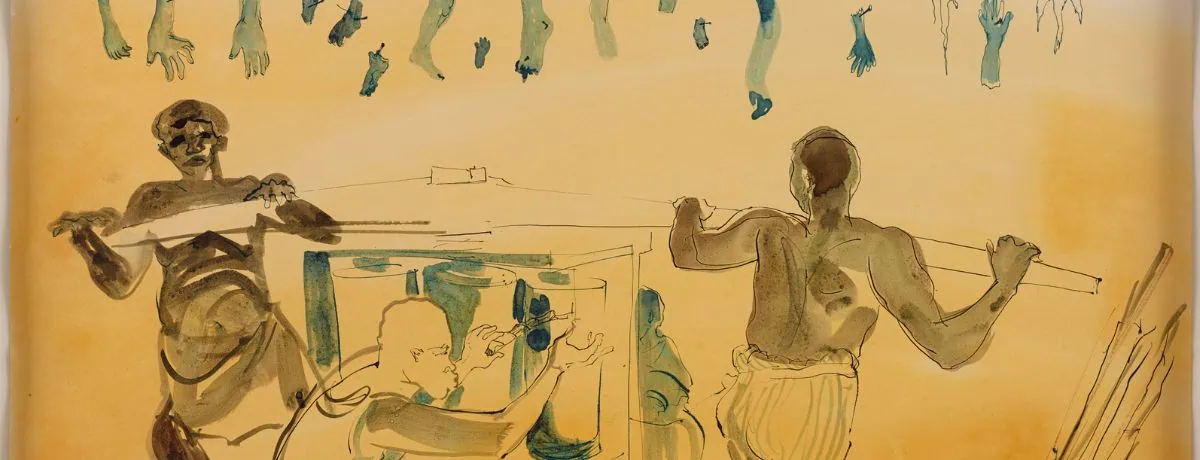
Image credit: © Kara Walker, courtesy of Sikkema Malloy Jenkins and Sprüth Magers
Kara Walker
Sugar Cane Prep in Yellow, 2014
Watercolor on paper
22 x 30 inches (55.9 x 76.2 cm)